Tour America's Treasures


An invitation to tour America's historical sites...

Thursday, January 12, 2012

City Hall Tower Sculptures


View City Hall (Philadelphia) in a larger map

Visit our  “Tour Destination: Philadelphia page to see the entire walking tour of the first Philadelphia cluster of Save America’s Treasures sites.


City Hall Tower Sculptures--specifically the
bronze statues below the William Penn
statue and above the clocks.
Photo courtesy of the City of Philadelphia
and Conservation of Sculpture and
Objects, Inc.

City Hall Tower Sculptures
Broad Street and Market Street
Philadelphia, PA


The Treasure:  Look beneath the famous statue of William Penn at the top of City Hall.  Approximately 100 feet below Penn (that’s only about a fifth of the way down the clock tower) are colossal bronze statues by Alexander Milne Calder.  They depict a Native American man with a dog, a Native American woman with a child, a Swedish woman with a lamb and a child, a Swedish man with a child, and bronze eagles. These statues are the treasure.

The City of Philadelphia's Public Art Program completed the restoration of these sculptures in early 2007 with the support of the Philadelphia Museum of Art, as well as generous funding support from Save America’s Treasures, The Pew Charitable Trusts, the National Endowment for the Arts, the Getty Foundation, and the City.

Accessibility:  The sculptures are situated on the clock tower of the building, approximately 400 feet above ground. They can be seen from the street level, but due to their great height, one cannot get close. Check the visitor information above for details on tours to explore all the treasures of City Hall.

The bronze Native American statue
midway through its restoration.
Photo courtesy of the City of Philadelphia
and Conservation of Sculpture and
Objects, Inc.
Notes:  The statue of William Penn at the top of City Hall is one of Philadelphia’s most iconic symbols. He’s in the record books, too, for being the tallest sculpture on top of any building in the world. The Penn statue is 37 feet tall and weighs 27 tons.

The eight bronze statues celebrated here for their Save America’s Treasures status are hardly less impressive. Installed in 1894, they are approximately 24 feet tall and weigh between 8 and 11 tons each. The eagles have a 15-foot wingspan and weight just over 3 tons.

These statues clearly demonstrate the vision and artistry of their sculptor, Alexander Milne Calder (1846-1923). But they are just the beginning of Calder’s contribution to City Hall. In all, Calder designed more than 250 relief and freestanding sculptures for the vast City Hall building, with the ambitious intent of expressing American ideals through history and allegory.

Notes from the Editor:  Working in Philadelphia, I’ve known for years about Billy Penn at the top of City Hall—famous for many years for setting a limit to the height of Philadelphia buildings (a “gentleman’s agreement” that was dropped in 1987 when Liberty Place exceeded the height of Penn’s hat). But all these other statues are delightful new discoveries for me.

I like Calder’s expansive approach to the statues near the top. William Penn gets top billing, but the next level of statues represent the people who were in Philadelphia before Penn and his fellow Englishmen arrived. Native Americans were here first. The Swedish were the first European settlers to make a home here between the Delaware and Schuylkill Rivers. The animals—a dog, a lamb, and an eagle—are classic symbols of fidelity, gentleness, and majesty. Taken together with William Penn, these statues form a peaceable kingdom at the top of City Hall.

A worker scales the City Hall exterior.  Visible
City Hall Tower Sculptures include a bronze eagle
and a Swedish woman with a lamb and a child.
Photo courtesy of the City of Philadelphia and
Vertical Access, LLC.

Other Recommended Sites:  Alexander Milne Calder was the grandfather who emigrated from Scotland, studied art under Thomas Eakins, and snagged the prestigious commission to furnish City Hall with sculptures. His son Alexander Stirling Calder (1870-1945) carried the Calder name to even greater heights, receiving commissions to create monumental sculptures in Philadelphia and throughout the world. Then his son Alexander Calder (1898-1976) revolutionized the field of sculpture with his famous mobile sculptures.

Philadelphia is home to sculptures by all three Calders. In addition to the statues of City Hall, check out the sculptures of the Swann Memorial Fountain at the center of Logan Circle (surrounded by the Free Library of Philadelphia, the Franklin Institute, and the Academy of Natural Sciences) that were done by Alexander Stirling Calder. To see one of his son’s famous mobiles, visit the Philadelphia Museum of Art, stand at the foot of the great stairs leading to the second floor, and gaze up at Calder’s mobile sculpture “Ghost.” 


The Native American man statue, restored by Conservation of Sculpture
and Objects Studio, Inc. Project Director: Andrzej Dajnowski.
Photo courtesy of the City of Philadelphia and Conservation of Sculpture
and Objects, Inc.

Tour America's History Itinerary
Monday’s destination:  African American Museum in Philadelphia
Tuesday’s destination:  Cruiser Olympia (Independence Seaport Museum)
Wednesday’s destination:  Submarine Becuna (Independence Seaport Museum)

© 2011 Lee Price


Wednesday, January 11, 2012

Academy of Music


View Academy of Music in a larger map

Visit our “Tour Destination: Philadelphia page to see the entire walking tour of the first Philadelphia cluster of Save America’s Treasures sites.


The Academy of Music as seen from Broad Street.
Photo by Tom Crane.

Academy of Music
Broad and Locust Streets
Philadelphia, PA

Website:  Academy of Music

The Treasure:  The 155-year-old Academy of Music is the oldest known continuously operating opera house in the United States. Constructed in 1857, the building was built using solid brick bearing walls and timber framed floors and roof.  A National Historic Landmark, the Academy of Music was home to The Philadelphia Orchestra from its founding in 1900 until the 2001 opening of their new home, The Kimmel Center for the Performing Arts. After more than a century and a half, the Academy of Music continues to be Philadelphia’s premier opera house.

Accessibility:  The main hall (capacity 2,897) is constantly in use for concerts, operas, ballets, and other events. The Ballroom (capacity 350) was inspired by the design of the Hall of Mirrors at VersaillesTours of the Academy are available and schedules may be obtained by contacting the manager's office.

Interior of the Academy of Music.
Photo by Joe Kaczmarek.
Notes:  The Academy of Music was built to be an opera house befitting one of the great cities of the 19th century. Opening with a Grand Ball and Promenade Concert in 1857, it boasted an opulent interior, a magnificent crystal chandelier, and extraordinary acoustics. For nearly a century and a half, the Academy of Music served as the home of the Philadelphia Orchestra. While the Philadelphia Orchestra now resides at the neighboring Kimmel Center for the Performing Arts, the Academy of Music continues to serve as home for the Pennsylvania Ballet and the Opera Company of Philadelphia.

Notes from the Editor:  When filming Edith Wharton’s The Age of Innocence, director Martin Scorsese and his crew were challenged to find a suitable replacement for the New York Academy of Music which had been torn down decades before.  Philadelphia’s Academy of Music was chosen after a review of 900 possible sites. As Scorsese determined, no existing American building beats Philadelphia’s Academy of Music for capturing the splendor of a 19th century major metropolitan opera house.

Other Recommended Sites:  For music, The Kimmel Center for the Performing Arts is right around the corner on Broad Street. Completed in 2001, the Kimmel is the new home of The Philadelphia Orchestra. But you can find music all around Philadelphia, in part because it is home to some of the country’s greatest music schools, including the Curtis Institute of Music, the Academy of Vocal Arts, and Settlement Music School.

Restored in 2008, the chandelier at the Academy of Music measures
25 feet high, 16 to 17 feet in diameter, and weighs 3,500 pounds.
It has been an integral part of the Academy of Music from the time
of its opening in 1857.
Photo by Julie Skarratt.

© 2011 Lee Price


Tuesday, January 10, 2012

Pennsylvania Academy of the Fine Arts


Visit our “Tour Destination: Philadelphia page to see the entire walking tour of the first Philadelphia cluster of Save America’s Treasures sites.

Both buildings of the Pennsylvania Academy of the Fine Arts,
with the Historic Landmark Building on the left and the
Hamilton Building on the right.
Photo by Tom Crane.

The Historic Landmark Building (Furness-Hewitt Building) of the
Pennsylvania Academy of the Fine Arts.
Photo by Tom Crane.

Pennsylvania Academy of the Fine Arts
118 North Broad Street (Historic Landmark Building)
128 North Broad Street (Hamilton Building)
Philadelphia, PA 19102


The Treasure:  The Pennsylvania Academy of the Fine Arts (PAFA) expanded its campus by acquiring and renovating the 11-story building at 128 North Broad Street, originally known as the Gomery-Schwartz Autocar Building.  Renamed the Samuel M.V. Hamilton Building by PAFA in 2002, the building sits directly north of PAFA’s Historic Landmark Building (Furness-Hewitt Building), with Lenfest Plaza between the two buildings.  PAFA’s renovation of the Hamilton Building, completed in 2005, created two floors of gallery space, and art studio and facilities, classrooms, and office space on the upper floors. 

Entrance to the
Hamilton Building.
Photo by Tom Crane.
Accessibility:  Access to both the Furness-Hewitt Building and the Samuel M.V. Hamilton Building is sidewalk-level from Broad Street. Sometimes referred to as the Historic Landmark Building, the Furness-Hewitt Building is the home of PAFA’s magnificent permanent collection.  The Hamilton Building’s galleries are used for a rotating schedule of special exhibitions.  Both buildings are open to the public Tuesday through Saturday, 10 to 5, and Sunday, from noon to 5:00, except during periods when the galleries are transitioning between exhibitions.  PAFA’s Portfolio store, fronting on Broad Street, is open seven days a week, except for major holidays, until 6 p.m. 

Notes:  The Pennsylvania Academy of the Fine Arts (PAFA) was founded in 1805 by painter and scientist Charles Willson Peale, sculptor William Rush, and other artists and business leaders. It is the oldest art museum and school in the nation.

Main staircase in the PAFA Hamilton Building
showing two floors of exhibition space.
Photo by Tom Crane.
PAFA’s Samuel M.V. Hamilton Building was designed by Charles Oelschlager in 1916.  For nearly three decades following its 1917 construction, this reinforced concrete building served as an automobile showroom, a service station, office space and storage area for the Gomery-Schwartz Autocar Company, a distributorship for Hudson Motor Cars.  It was later acquired by the federal government.  As a historic structure, it has been recognized for its role in the early automotive history of Philadelphia, with its lavish showroom interiors and soaring loft spaces that represented cutting-edge architectural thinking in the early 20th century.

The building was purchased by PAFA in 2002 and formally renamed the Samuel M.V. Hamilton Building in memory of PAFA board member “Sam” Hamilton.  Renovations to the building allowed for the restoration of the Broad and Cherry Street facades to their original early 20th century appearances.  (Material for these notes drawn from excerpts from an essay by Peter M. Saylor, FAIA, of Dagit Saylor Architects.)

Notes from the Editor:  Technically speaking, PAFA’s Samuel M.V. Hamilton Building  received the Save America’s Treasures treatment.  The restored façade recalls the Philadelphia of a century ago and nicely sets off the neighboring Historic Landmark Building.

But I have to say a word here for that world-class architectural masterpiece, PAFA’s Historic Landmark Building.  You simply can’t check off the Hamilton Building on your Save America’s Treasures tour and skip the masterpiece next door.  Designed by the Philadelphia firm of Frank Furness and George Hewitt, the Historic Landmark Building has remained a classic example of Furness’ architectural genius ever since it opened in 1876.  Both the exterior and the interior are magnificent and, thanks to the ongoing work of PAFA, the building remains as impressive today as ever.  The interior Grand Stairhall, which climbs to the main exhibition area for the permanent collection, still takes my breath away every time and that’s after many visits.

"Walt Whitman" (1887-1888), oil on canvas
by Thomas Eakins from the Pennsylvania
Academy of the Fine Arts.
Source: Wikimedia Commons.
And then there’s the amazing art collection with important works by key American artists including Charles Willson Peale and other members of his illustrious Philadelphia family, Thomas Eakins, Henry Ossawa Tanner, Benjamin West, Mary Cassat, Daniel Garber, and William Merritt Chase.

Several years ago, PAFA’s President published a list of ten of his favorite artworks from the collection and then asked others to send in their favorites.  Here’s my complementary list of ten other PAFA favorites that I sent in:  “Bacchante” (1872) by Mary Cassatt;  “Walt Whitman” (1888) by Thomas Eakins;  “Still Life, Fish” (1903) by William Merritt Chase;  “Wee Maureen” (1926) by Robert Henri;  “Sparrows” by Joseph Stella;  “Rose Hobart” (1934) by Luigi Lucioni;  “Naples Yellow Morning” (1935) by Arthur Dove;  and “Young Woman” (1937) by Isabel Bishop.  See if you can find some of them when you visit!

Interior Grand Stairhall in the Historic Landmark Building of the
Pennsylvania Academy of the Fine Arts.
Photo by Tom Crane.

Tour America's History Itinerary
Wednesday’s destination: The Academy of Music


© 2011 Lee Price

Monday, January 9, 2012

The Library Company of Philadelphia


View The Library Company of Philadelphia in a larger map

Visit our “Tour Destination: Philadelphia page to see the entire walking tour of the first Philadelphia cluster of Save America’s Treasures sites.

The Library Company of Philadelphia.

Craven Street (London) platform at the traveling exhibition
"Benjamin Franklin: In Search of a Better World."
Courtesy Benjamin Franklin 300.

The Library Company of Philadelphia
1314 Locust Street
Philadelphia, PA

and

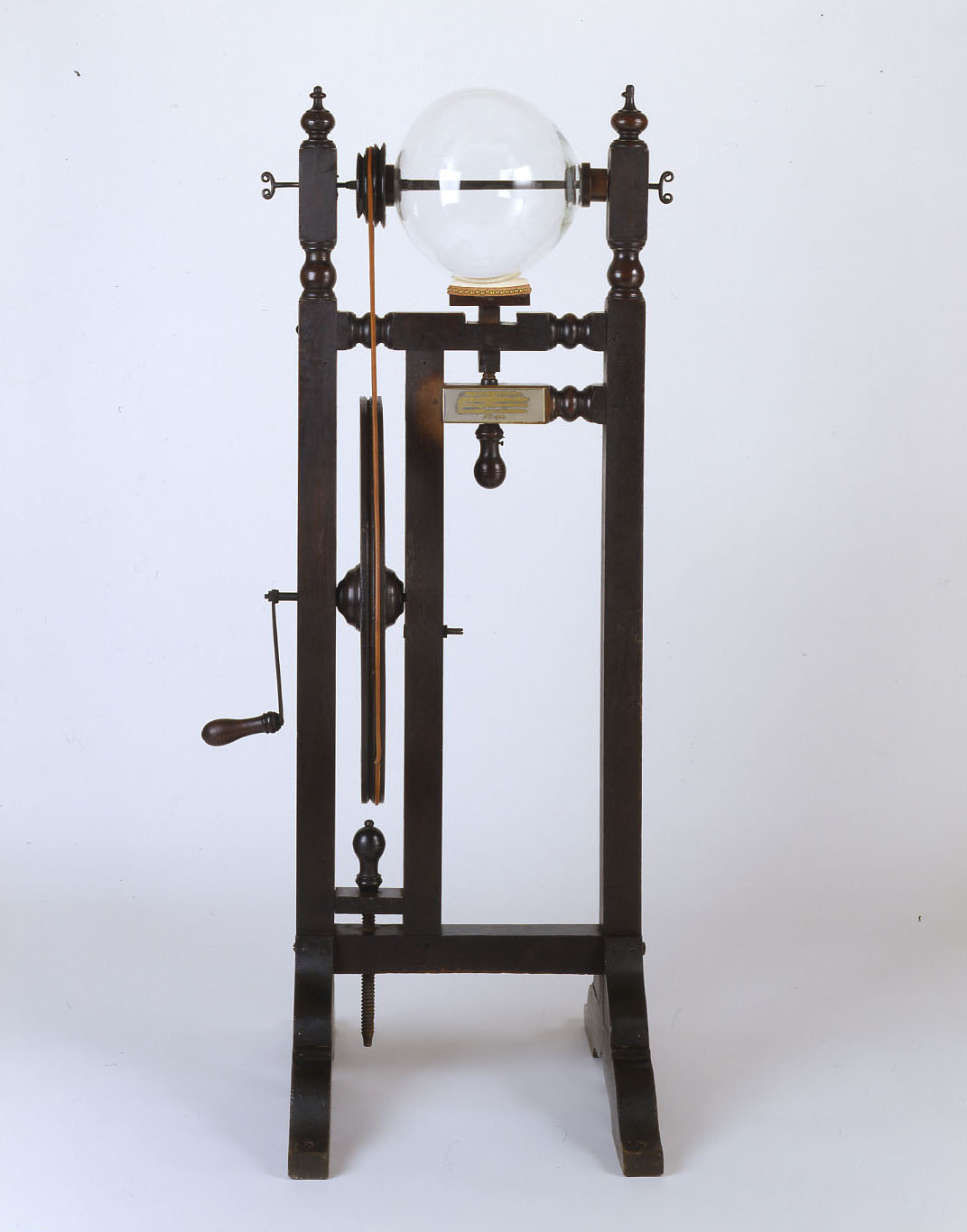
The Treasure:  The Library Company of Philadelphia served as the lead agency in an application for a Save America’s Treasures grant to conserve Benjamin Franklin-related items at many sites.  These items were included in a major traveling exhibition sponsored by the Benjamin Franklin Tercentenary Commission, formed to organize exhibitions and other projects to celebrate the 300th anniversary of Franklin’s birth.  Some of the conserved treasures included:

Electrical Machine, ca. 1742-1747,
designed by Benjamin Franklin.
Walnut, glass, iron, and leather.
59" x 28" x 24"
Library Company of Philadelphia,
Gift of Benjamin Franklin Bache, 1792. 
    Franklin’s electrical machine from the Library Company collection:  “The machine first used by Dr. Franklin in making electrical experiments.”
    Books from Franklin’s personal library from the Library Company collection
    Franklin imprints (newspapers, books, pamphlets, and broadsides) from the Library Company collection
    A Franklin-designed library chair from the American Philosophical Society
    The only surviving Franklin stoveplate from Historic Bartram’s Garden
    The only existing first issue of the first edition of the 1733 Poor Richard’s Almanack from the Rosenbach Museum and Library
    Franklin’s glass armonica from the Franklin Institute
    Portrait bust of Franklin by Jean-Antoine Houdon from the Philadelphia Museum of Art
    Franklin’s promotional fundraising booklet Some Account of the Pennsylvania Hospital (1756) from Pennsylvania Hospital
    An odometer designed by Franklin from the Franklin Institute
    And many other treasures from the above sites and others, including Independence National Historical Park, the Annenberg Rare Book and Manuscript Library at the University of Pennsylvania, and the Philadelphia History Museum at the Atwater Kent.

Library Company of Philadelphia Accessibility:  The Library Company of Philadelphia is open to the public free of charge.

Benjamin Franklin’s Electrical Machine is on view in the Logan Room, a gallery for their permanent collection of art and artifacts. (Note: It will be on loan from Sept.-Dec. 2012.) Here is a panorama of the Logan Room offering a 360 degree view. The Electrical Machine can also be seen through the Library Company’s online exhibition.

The Benjamin Franklin Tercentenary exhibition Benjamin Franklin: In Search of a Better World will be on display at the National Archives (Washington, DC) from February 10 to May 6, 2012.

The Library Company of Philadelphia.
Notes on the Library Company of Philadelphia:  The Library Company is America’s first successful lending library and oldest cultural institution. It was founded in 1731 by Benjamin Franklin as a subscription library supported by its shareholders, as it is to this day.

During the early years of the United States, books were not widely available. Standard English reference works were expensive and difficult to find: they had to be shipped to the colonies from Europe, and the average person could not afford to purchase the books that well-rounded intellectuals thought worth reading.

In 1731, Benjamin Franklin convinced members of the Junto, his “society of mutual improvement,” to pool their resources and purchase a collection of books none could have afforded individually. Articles of Agreement were drafted on July 1, 1731, and the Library Company of Philadelphia was established when 50 founding shareholders signed on. Each contributed 40 shillings and agreed to pay ten shillings per year thereafter. As the Library Company’s collection grew, the book capital of each shareholder expanded as well.

The collections grew with the nation and reflect the country’s many faces and varied interests. From the Revolutionary War to 1800, when the national government was in Philadelphia, the Library Company also served as the Library of Congress. Until the 1850s it was the largest public library in America. All of the books the Library Company acquired year by year over more than two and a half centuries are still on its shelves, along with many others added since it was transformed into a research library in the 1950s. In the 21st century, the Library Company serves as a resource for a variety of readers, from high school students to senior scholars, from novelists to film producers, and anyone else with an interest in their collections.

Notes from the Editor:  This one is very special to me as I wrote the successful Save America’s Treasures request for this project. Franklin artifacts had been largely dispersed in the decades following his death. It was thrilling to see so many important historic artifacts come together for the first time in centuries for the great Benjamin Franklin Tercentenary exhibition that opened at the National Constitution Center (Philadelphia, PA) in 2005.

Science platform at the traveling exhibition
"Benjamin Franklin: In Search of a Better World."
Courtesy Benjamin Franklin 300.
Subsequently, the blockbuster exhibition Benjamin Franklin: In Search of a Better World traveled to the Missouri History Museum (St. Louis, MO), the Houston Museum of Natural Science (Houston, TX), the Denver Museum of Nature and Science (Denver, CO), and the Atlanta History Center (Atlanta, GA), concluding with exhibitions at the Musée Carnavalet and the Musée des Arts et Métiers (Paris, France) in honor of Franklin’s achievements as Ambassador to France during the Revolutionary War. The exhibition was then reprised, in a somewhat smaller configuration, by the Minnesota Historical Society and after its showing in Minneapolis, it has traveled to the Bowers Museum (Santa Ana, CA), the Heinz History Center (Pittsburgh, PA), and the Gerald Ford Presidential Library (Grand Rapids, MI). Its final venue will be the National Archives in Washington, DC, where it will be on view from February 10 to May 6, 2012.

Conservators at the Conservation Center for Art and Historic Artifacts were responsible for overseeing the conservation treatment for the entire project. The Conservation Center treated and rehoused most of the manuscript and printed materials and managed work by paintings conservator Steven Erisoty, objects conservator Kory Berrett, furniture conservator Tom Heller, and textile conservator Virginia Whelan. In addition, conservation work was performed at in-house laboratories at the Library Company of Philadelphia, the Philadelphia Museum of Art, and the American Philosophical Society.

Many of the conserved items continue to be featured on the Benjamin Franklin Tercentenary website. In addition, key items were depicted on a traveling panel exhibit, sponsored by the American Library Association and funded by the National Endowment for the Humanities, which traveled to 40 libraries in 31 states through 2011. Thanks to these exhibitions, hundreds of thousands of people were able to learn about Benjamin Franklin through the authentic American treasures that serve as signposts to Franklin’s life and achievements.

Other Recommended Sites:  Visit other sites that have original Franklin items that were conserved through Save America’s Treasures. These sites include:  the American Philosophical Society, the Franklin Institute, the Philadelphia Museum of Art, the Rosenbach Museum and Library, Bartram’s Garden, Independence National Historic Park, the Annenberg Rare Book and Manuscript Library at the University of Pennsylvania, the Philadelphia History Museum at the Atwater Kent, and Pennsylvania Hospital.

Market Street (Philadelphia) platform at the traveling exhibition
"Benjamin Franklin: In Search of a Better World."
Courtesy Benjamin Franklin 300.

Tour America's History Itinerary
Tuesday’s destination:  Pennsylvania Academy of the Fine Arts
Wednesday’s destination:  The Academy of Music

© 2011 Lee Price

Friday, January 6, 2012

Pennsylvania Hospital, the Pine Building


View Pennsylvania Hospital, the Pine Building in a larger map

Visit our “Tour Destination: Philadelphia” page to see the entire walking tour of the first Philadelphia cluster of Save America’s Treasures sites.

Pennsylvania Hospital, the Pine Building.
Pennsylvania Hospital, the Pine Building
Pine Street, between 8th and 9th
Philadelphia, PA


The Treasure:  The Pennsylvania Hospital is the nation’s first hospital and a designated National Historic Landmark.  Founded by Dr. Thomas Bond and Benjamin Franklin, the hospital was chartered in 1751 by the colonial government as the first institution in America organized exclusively for the treatment and care of the sick poor and mentally ill. The Pennsylvania Hospital became a primary force in shaping the attitude of colonial Americans toward persons with emotional and psychological disorders, as well as advancing the practice of clinical medicine through Dr. Bond’s lectures to medical students at the hospital. 

Accessibility:  Visitors may enjoy a tour of the Center Building, the third and final section that completes the Pine Building.  For guided or self-guided tours of the Historic Pine Building, please visit their Historic Tours page.

For a leisurely tour at home, click here for a virtual tour of the Pine Building.

Pennsylvania Hospital.
Notes:  The Pine Building, the oldest building of the hospital campus, was completed in three sections, the East Wing, the West Wing, and the Center Wing.  The East Wing was built in 1755, and the West Wing was constructed in 1796 to separate the mentally ill from the physically ill patients.  The Center Wing joined the two buildings in 1804.  The Hospital continues to use these original buildings for administrative offices, the Archives, and as the core of our historic tours. 

The Medical Library at Pennsylvania Hospital was established in 1762 when Dr. William Shippen, Jr. presented a book, anatomical drawings, and three anatomical plaster casts from Dr. John Fothergill, a London physician and a friend of Franklin and Bond.  The library is the first and oldest library of its kind in the country, and in 1847 the American Medical Association designated it as the first, largest, and most important medical library in the United States.  Today the library houses approximately 13,000 volumes, many of which are found in only a handful of other institutions in the world.  Acquired books focus on anatomy, botany, obstetrics and mental illness, and the holdings include such classics as the works of Vesalius, Linnaeus, and Catesby’s Natural History of Carolina.  The Hospital’s collection of fine art includes paintings, portraits, engravings, and sculpture of key subjects in the Hospital’s history.  There are several works by important artists, such as Thomas Sully, Benjamin West, and Thomas Eakins.  Hospital staff, patients, the general public, historians, and students of art appreciate these works on a daily basis.

The Archives, housed in the East Wing of the Pine Building, provide a record that reflects the development of healthcare and medical education from the 18th to the 20th century.  Open to the public via appointment, the Archives attracts scholars interested in the history of hospital development, health care, medicine, nursing, society, culture, nationality and race, and architecture.  The archival records are comprised of organizational records (many in Benjamin Franklin’s personal hand as President and Clerk of the hospital), personal papers of nurses, physicians (including Benjamin Rush and Phillip Syng Physick), photographs, artifacts, engravings, and scrapbooks, as well as the records of affiliates absorbed by Pennsylvania Hospital and the Institute of Pennsylvania Hospital.  The surgical amphitheatre, located in the Center Building and in use from 1804-1868, helped to inaugurate American clinical teaching by bringing the patient into the lecture room with the students. Dr. Benjamin Coates initiated the practice of demonstrating with patients in 1834.  Distinguished physicians who have used the amphitheatre over the years include: Dr. Phillip Syng Physick, Dr. George W. Norris, Dr. Joseph Pancoast, Dr. D. Hayes Agnew, and Dr. Thomas G. Morton.

18th century over-sized anatomical
drawing from the Medical Library
at Pennsylvania Hospital.
Notes from the Editor:  Pennsylvania Hospital’s surgical amphitheatre, mentioned above, is one of Philadelphia’s great architectural spaces.  The space is haunted by history in an almost uncanny way.

At the Conservation Center for Art and Historic Artifacts, I’ve been lucky to see numerous great items come from Pennsylvania Hospital for treatment.  While it’s always great to see Benjamin Franklin signatures pass through, the real treat for me has been the books and prints from the early days of medical illustration—tantalizingly graphic and always beautifully executed.

Other Recommended Sites:  For those who enjoy touring the Pennsylvania Hospital, other sites to visit include: the Philip Syng Physick House and the College of Physicians of Philadelphia and its famous Mütter Museum.

The historic surgical amphitheatre at Pennsylvania Hospital.

Tour America's History Itinerary
Monday’s destination: The Library Company of Philadelphia
Tuesday’s destination: Pennsylvania Academy of the Fine Arts
Wednesday’s destination: The Academy of Music


© 2011 Lee Price

Thursday, January 5, 2012

Christ Church


View Christ Church in a larger map

Visit our “Tour Destination: Philadelphia page to see the entire walking tour of the first Philadelphia cluster of Save America’s Treasures sites.

Christ Church as seen from 2nd Street.
Photo by Tom Crane.

Christ Church
2nd Street above Market Street
Philadelphia, PA


The Treasure:  Christ Church dates to 1695 as the first Church of England parish in Pennsylvania.  The current structure was built between 1727 and 1744.

Accessibility:  The church is open to the public free of charge 7 days a week (closed in the winter on Monday and Tuesday).  History guides are on site to provide further information.

Christ Church in 1879.
Notes:  Christ Church is called the Nation’s Church because of its role during the Colonial and Revolutionary War eras.  Benjamin Franklin, George Washington, Robert Morris, Absalom Jones, Elizabeth Graham Fergusson and other early leaders were members of Christ Church.  Seven of the 56 signers of the Declaration of Independence are buried at the church or the nearby Christ Church Burial Ground.

Christ Church was the largest structure in North America when it was finished in 1744.  The steeple, completed in 1754 by the architect Robert Smith, was the highest structure in North America for 56 years.

Notable features of the church include the grand Palladian window (one of the first in America) and the 200-foot-tall steeple that was built using funds from a lottery organized by Benjamin Franklin (and famously climbed by John Adams in 1774).  The balconies and pews were re-built in 1835 under the guidance of Thomas U. Walter.  Currently on display is a 1702 bell from the original church, one of the earliest bells in America.

Preservation projects have happened at regular intervals throughout the 300+ year history.  Most recently, the exterior of the church underwent a $2.5 million preservation program and fire safety systems were added to the interior.  Support for this work came, in part, from Save America’s Treasures.

Christ Church, side view.
Photo by Tom Crane.
Notes from the Editor:  Well into its fourth (!) century of service, Christ Church continues to thrive as a center of community in Old City Philadelphia.  Their preservation work through the nonprofit Christ Church Preservation Trust is exemplary—they are passionate about preserving their past and meticulous in their attention to detail.

One of my particular favorite items from their collections is the page in the 1776 Vestry minutes where the minister crossed out references to the royal family.  Looking at this page, you suddenly get the feel of real people making life-or-death decisions about their allegiances in a time of change and uncertainty.

Other Recommended Sites:  Don’t miss the Christ Church Burial Ground where five signers (including Benjamin Franklin) of the Declaration of Independence are buried.  The Burial Ground is open March through December, closing for the winter months.  From the Christ Church website, you can download a map of the Burial Ground that will help you locate the final resting places of many national and regional leaders.

Other historic sites in the immediate neighborhood include Elfreth’s Alley and the Betsy Ross House.

Interior of Christ Church.
Photo by Tom Crane.

Tour America's History Itinerary 
Tomorrow’s destination:  Pennsylvania Hospital

© 2011 Lee Price