Tour America's Treasures


An invitation to tour America's historical sites...

Monday, April 2, 2012

Little Rock Central High School


Visit our Tour Destination: Arkansas page to see the entire tour of the state’s Save America’s Treasures sites.

Little Rock Central High School.
Photo courtesy Little Rock Central High School National Historic Site.

Little Rock Central High School Visitor Center
2120 Daisy Bates Drive
Little Rock, AR


The Treasure:  Little Rock Central High School possesses enormous symbolic significance in the struggle for African-American civil rights as the location where long-standing policies of school segregation were publicly challenged.

Accessibility:  The Little Rock Central High School Visitor Center is open daily from 9 to 4:30.

Background:  On September 23, 1957, nine teenagers went to school… and the United States changed forever. The “Little Rock Nine” entered American history that day as symbols of youthful courage in the face of anger and racism. The U.S. Supreme Court had supported the right of African-American youth to attend public schools designated as “white only” three years earlier, but it took a federal/state showdown in Little Rock to transform the legal right into a reality.

Students escorted into Central High School by 101st
Airborne Division on September 25, 1957.
Source: Wikimedia Commons
Police protected the Little Rock Nine as they entered Central High School on September 23 but escalating violence outside the school led to the students’ swift removal, escorted out soon after being escorted in. Two days later, on September 25, over a thousand members of the 101st Airborne Division escorted the Little Rock Nine safely into the school where they enjoyed their first full day of classes.

On a national level, the events of this period demonstrated the federal commitment to enforcing equal civil rights for all U.S. citizens, regardless of race. The U.S. Supreme Court’s 1954 Brown v. Board of Education of Topeka decision promised an end to practices of school segregation and a new era of integration in which black and white students would be entitled to the same quality of public education. President Dwight D. Eisenhower called out the federal troops to Little Rock to enforce the Supreme Court decision. Angry mobs opposing the integration of Central High School received vocal support from Arkansas Governor Orval Faubus.

The showdown between Eisenhower and Faubus continued to simmer over the next two years, creating enormous stress at the school under the glare of international media attention. Three of the Little Rock Nine students completed their high school studies at Central High School, with Ernest Green becoming the first African-American student to graduate from Central High School on May 25, 1958.

The Little Rock Nine were:  Ernest Green, Elizabeth Eckford, Jefferson Thomas, Terrence Roberts, Carlotta Walls, Minnijean Brown, Gloria Ray, Thelma Mothershed, and Melba Pattillo.

Notes from the Editor:  Central High School continues to educate a fully-integrated student body today. In fact it’s the only still-operating high school in the country to be awarded the distinction of being a National Historic Site. President Bill Clinton signed the legislation in 1998, recognizing the important role this school from his own native state had played on the national stage.

Preserved Mobil Station where reporters would gather
during the events of the late 1950s.  Photo courtesy of
Little Rock Central High School National Historic Site.
For visitors, everything can be found at the intersection of Daisy Bates Drive and South Park Street. The school is on the southwest corner, a commemorative garden is on the northwest corner, the Visitor Center is on the northeast corner, and a preserved Mobil gas station is on the southeast corner.

At the Central High School Visitor Center, you can experience multimedia exhibits and see a film on the historic events at Central High School in the late 1950s. A Mobil gas station that served as a gathering area for reporters in the 1950s has been preserved on the other side of Daisy Bates Drive.

There is a Central High Commemorative Garden across Park Street from the Visitor Center. Embedded within arches at the park are photographs depicting both the time of crisis and the successful integration of the school in the years that followed. In honor of the Little Rock Nine, there are nine trees and benches.

Other Recommended Sites:  Arkansas is justly proud of its many National Parks and State Parks. Central High School is one of seven National Park sites in the state. The others are: Arkansas Post National Memorial, Buffalo National River, Clinton Birthplace National Historic Site, Fort Smith National Historic Site, Hot Springs National Park, and Pea Ridge National Military Park.

There are 52 Arkansas State Parks where visitors can explore the natural beauty of Arkansas’ mountains, valleys, forests, and rivers, as well as important historic sites such as prehistoric Native American mound sites and Civil War battlefields.

New York City Mayor Robert Wagner greets the Little Rock Nine in 1958.
Pictured, front row, left to right:  Minnijean Brown, Elizabeth Eckford,
Carlotta Walls, Mayor Wagner, Thelma Mothershed, Gloria Ray;
back row, left to right:  Terrence Roberts, Ernest Green, Melba Pattilo,
and Jefferson Thomas.  World Telegram photo by Walter Albertin.
Source: Wikimedia Commons

Tour America's History Itinerary
Wednesday’s destination:  Eureka Springs City Auditorium
Friday’s destination:  Camp Ouachita

© 2012 Lee Price

Friday, March 30, 2012

Old State House Museum: Civil War Battle Flag Collection


View Old State House Museum in a larger map

Visit our Tour Destination: Arkansas page to see the entire tour of the state’s Save America’s Treasures sites.


Before treatment:  Confederate Second National pattern battle flag.
Photo courtesy Old State House Museum.

After treatment:  Confederate Second National pattern battle flag.
Photo courtesy Old State House Museum.

Old State House Museum
300 West Markham
Little Rock, AR


The Treasure:  The Old State House Museum in Little Rock preserves twenty historic Civil War battle flags including representatives of Confederate “National” flags, St. Andrew’s Cross, and the Hardee Pattern, as well as other battle flags.

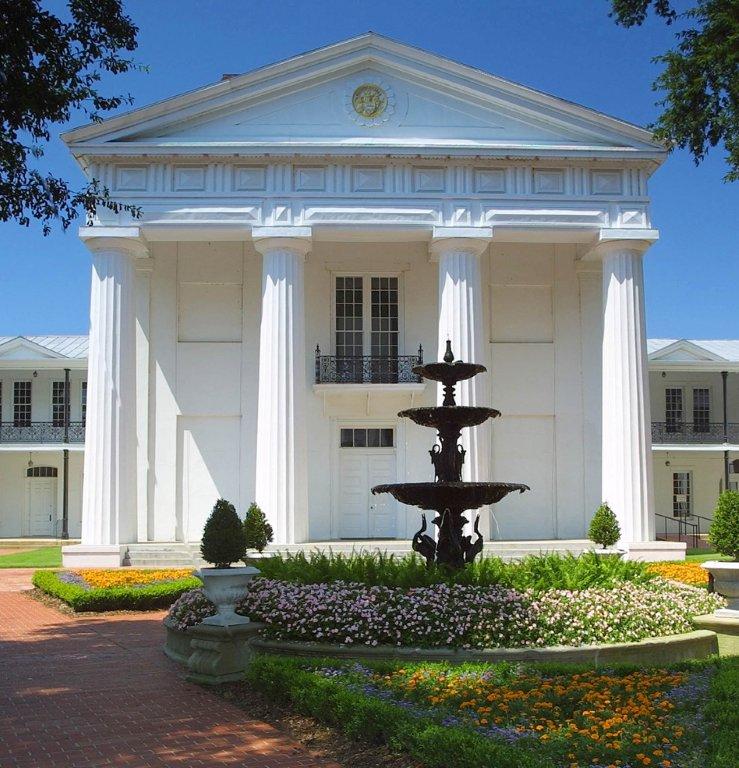
The Old State House Museum
in Little Rock. Photo courtesy
Old State House Museum.
Accessibility:  The Old State House Museum is open Monday through Saturday from 9 to 5, and Sunday from 1 to 5. The oldest standing state capitol building west of the Mississippi, the Old State House Museum has a fascinating history of its own. Permanent exhibitions tell the story of the historic building, with complementary exhibitions that explore subjects such as Arkansas political history and the legacy of Arkansas women.

The Civil War battle flags are very fragile and can only be safely displayed under controlled conditions for brief periods of time. There will be some limited display of the flags during the five exhibitions planned for the Civil War Sesquicentennial (2011-2015).

For immediate armchair accessibility, the twenty battle flags in the collection have been digitized and may be viewed online.

Background:  Flags are no longer the essential tools of war they once were. In the chaos of a Civil War battle, a flag lifted high above the fray provided visual orientation and a needed rallying point. When the flag dropped out of sight, confusion could quickly take hold.

Soldiers knew their flags and invested them with strong emotion. The flag symbolized their companions, their cause, and their regional identity. As long as the flag was held high, it symbolized hope, too.

The Old State House Museum in Little Rock preserves a remarkable collection of twenty Civil War battle flags. Each of them speaks to Arkansas’ role in the unfolding war. The collection is unique in possessing examples of all three major patterns of flags distributed to units of the Confederate Army of Tennessee.

The captured Confederate flags were retained by the United States War Department in the decades following the Civil War. The South’s vigorous participation in the Spanish-American War led to a formal gesture of reconciliation in 1905 as the federal government returned the captured battle flags to their states. In the 1950s, the State of Arkansas entrusted its Civil War battle flags to the care of the Old State House Museum.

Notes from the Editor:  Three flags from this collection were designated for special conservation treatment through Save America’s Treasures funding. As with all textiles, flags deteriorate as they age. Prolonged light exposure can distort their colors and the fabric itself can become brittle. Old attempts to create supports for the flags actually served to accelerate their deterioration. Fastened to an acidic surface, the pigments and fibers of the flags suffered further degradation. (In the before and after treatment images on this page, the acidic supports have been removed in the "after" image.)

The good news is that this flag collection can be conserved. Fundraising for the Civil War Flag Preservation Project continues at the Old State House Museum. This brief video offers a glimpse inside the museum and an introduction to the flag preservation cause:


Here’s more information on the fundraising campaign and a direct link to the online donation page where you can make a contribution toward saving Arkansas’ Civil War battle flags.

Other Recommended Sites:  A century and a half ago, the Civil War was raging. Today, the sesquicentennial is offering nearly countless opportunities to commemorate and honor our shared past. The Arkansas Civil War Sesquicentennial Commission has mounted an easy-to-navigate website that links to information on events and exhibitions planned throughout the state, as well as detailed information on Arkansas’ role in the war.


Before treatment:  Confederate First National pattern flag attributed to
"Hart's Battery."  Photo courtesy Old State House Museum.

After treatment:  Confederate First National pattern flag attributed to
"Hart's Battery."  Photo courtesy Old State House Museum.

Tour America's History Itinerary
Monday’s destination:  Little Rock Central High School
Wednesday’s destination:  Eureka Springs City Auditorium

© 2012 Lee Price

Wednesday, March 28, 2012

Lakeport Plantation


View Lakeport Plantation in a larger map

Visit our Tour Destination: Arkansas page to see the entire tour of the state’s Save America’s Treasures sites.


Lakeport Plantation Home, now restored and open to the public
as an Arkansas State University Heritage Site.
Photo courtesy of Lakeport Plantation.

Lakeport Plantation
601 State Highway 142
Lake Village, AR


The Treasure:  The Lakeport Plantation house is Arkansas’ grandest remaining example of antebellum Greek Revival architecture.

Accessibility:  Arkansas State University operates Lakeport Plantation as a museum and educational center. Tours are available Monday through Friday at 10 a.m. and 2 p.m.

Background:  Joel Johnson moved down from Kentucky in 1831, purchasing this undeveloped tract of land in Chicot County, Arkansas. The soil was rich, benefiting from the Mississippi floods, but it’s hard to fathom the amount of work that must have gone into turning this area’s primordial swamp and forest into a major cotton plantation. Johnson and his 23 slaves undertook the work of clearing the land. Over the next 15 years, Johnson significantly expanded his holdings, owning over 3,700 acres and 95 slaves at his death in 1846.

Charlotte Mitchell, "Mammy Charlotte,"
former slave on the Lakeport Plantation,
circa 1915.  Photo courtesy of
Lakeport Plantation
Johnson’s oldest son Lycurgus Leonidas Johnson inherited much of this land. Lycurgus continued to grow the family business. Some years later, he embarked in 1858 upon the building of a Greek Revival plantation house appropriate for a very successful gentleman farmer. The house was designed to showcase the Johnson family’s success and large enough to cordially welcome respectable gentlemen and ladies, albeit somewhat more modestly than some of the other grand Southern plantations.

But the years of prosperity were brief. The Civil War hit Chicot County hard, located as it was along the heavily-trafficked Mississippi River. The countryside was devastated and slavery came to an end, radically changing the economics of running a large cotton plantation. But Lycurgus emerged from the war in surprisingly good shape. He had a reputation for fairness and succeeded in negotiating terms to build a new work force for his plantation. He died at the age of 58 in 1876, with an intact reputation for modesty, kindness, and hospitality.

Today Arkansas State University operates Lakeport Plantation, using the historic building and grounds to research and interpret the people and cultures that shaped plantation life in the Mississippi River delta. Through exhibits and programming, they explore many themes, including the westward push for new agricultural lands and the pivotal role of African-Americans in shaping the culture of the region.

Original circa 1860 floorcloth uncovered in the entryway of
Lakeport Planation.
Photo courtesy of Lakeport Plantation.

Cleaning the floorcloth.
Photo courtesy of Lakeport Plantation.

Notes from the Editor:  I like this Google Satellite view of the area around the Lakeport Plantation:


Just look at that magnificent oxbow lake! Lake Chicot is the largest natural lake in Arkansas and the largest oxbow lake in all North America.

The Lakeport Plantation is located to the southeast of the oxbow, just west of the Mississippi River (with the plantation house facing east, looking across the river to the state of Mississippi). Joel Johnson took full advantage of the rich soil found in areas like this, but he also had to deal with a serious ongoing threat of flooding that prompted his son Lycurgus to wisely build his plantation house on a slight elevation and then further set the first floor an additional four feet above ground level.

Before the Johnson family and their large workforce of slaves tamed this land, it was a swampy area, overgrown with cypress and tupelo trees. Water moccasins and malaria-carrying mosquitoes were a constant threat. Travel on horseback through the dense wilderness, mud, and brackish water was treacherous. All this was transformed by the determination of the Johnson family and the slaves who worked for them. Approximately twenty years after Joel Johnson arrived to make a home in Arkansas, a northern visitor described the plantations of Chicot County as being “like a continuous garden all under cultivation, raising a bale of cotton to the acre.”

Other Recommended Sites:  For more on the Civil War in this part of Arkansas, there’s a wayside marker and a cell phone tour on Highway 82 to commemorate the Battle of Ditch Bayou. For relaxation, Lake Chicot State Park is located on the northeast bend of the oxbow—it’s one of Arkansas’ many scenic state parks.

During World War II, two Japanese internment camps were located nearby. To the north in Desha County, Rohwer Relocation Center is remembered through its camp cemetery, now a National Historic Landmark. At the age of five, George Takei (later Mr. Sulu on Star Trek) was brought to Rohwer with his family. The other internment camp was Jerome Relocation Center, located on the border of Drew and Chicot Counties and now commemorated with a monument marking the former camp. Over a period of three years, 1942 to 1945, approximately 16,000 Japanese Americans were incarcerated in these two Arkansas camps.

Cotton field and the Lakeport Plantation Home with the Highway 82
bridge across the Mississippi River in the background.
Photo courtesy of Lakeport Plantation.

Tour America's History Itinerary
Friday’s destination:  Old State House Museum
Monday’s destination:  Little Rock Central High School

© 2012 Lee Price

Monday, March 26, 2012

Tour Destination: Arkansas


View Arkansas in a larger map


To date, Tour America’s History has hugged America’s coasts with our coverage of Philadelphia, Richmond, and Southern California. As we approach Arkansas, I feel like we’re plunging into the heartland at last!

Two things influenced my choice to cover the Arkansas Save America’s Treasures sites next. First, my family had a wonderful time exploring northern Arkansas when we organized a Laura Ingalls Wilder tour of the Midwest several years ago. Since the Ingalls/Wilder family (of Little House on the Prairie fame) had close ties with the Ozarks, it felt appropriate for us to venture further south from Wilder’s home in Mansfield, Missouri into the rugged landscapes of the Arkansas Ozark Mountains. My son and I were so impressed by the beauty of the area that we later co-wrote a young adult fantasy novel centered there.

Second, I thought it would be appropriate to acknowledge the major splash that Arkansas has made on the international art stage this year with the opening of the Crystal Bridges Museum of American Art. The museum’s amazing collection significantly adds to the density of American treasures in the state, making Arkansas even more attractive as a major American tourist destination.

Little Rock is the largest city in Arkansas, located near the center of the state. From Little Rock, the Ozarks are to the north, the Delta region to the east, the Timberlands to the south, and the River Valley and Ouachita regions to the west. For planning your trip, helpful tourist sites include the Arkansas Tourism Official Site and Arkansas Tourism.

Our Tour America’s History exploration of Arkansas’ six Save America’s Treasures sites begins on Wednesday.

Tour America's History Itinerary
Wednesday’s destination:  Lakeport Plantation
Friday’s destination:  Old State House Museum

© 2012 Lee Price

Friday, March 23, 2012

UCR/California Museum of Photography: The Keystone-Mast Collection


Visit our Tour Destination: Southern California page to see the entire tour of the area’s Save America’s Treasures sites. 

This stereoscopic image of Russian peasants in a village in the
late 19th century is from the Keystone-Mast Collection.  When viewed
through a stereoscope, the image appears to be three-dimensional.
Photo courtesy of UCR/California Museum of Photography.

UCR/California Museum of Photography
3824 Main Street
Riverside, CA

Website:  UCR/CMP

The Treasure:  The Keystone-Mast Collection at the UCR/California Museum of Photography is the world’s largest and most significant stereoscopic imagery collection. It consists of 250,000 stereoscopic glass-plate and film negatives and 100,000 vintage prints that depict global culture from 1870 through the mid-1960s.

Accessibility:  The UCR/California Museum of Photography is internationally recognized for its magnificent photography collections. Visit the museum for its great changing exhibits of contemporary and historic photography, and for an introduction to the vast holdings of their permanent collection. The museum is open Tuesday through Saturday from noon to 5.

Items in the Keystone-Mast Collection, including the glass negatives, may be viewed on-site by appointment. For the layperson with a more casual interest in the fascinating world of historic stereoscopic photography, the best access to the Keystone-Mast Collection is via the internet. Go to Guide to Keystone-Mast Collection,1870-1963, a part of the Online Archive of California, and click on “Online items available.” At this site, you can browse nearly 40,000 digitized historic images from the Keystone-Mast Collection. Click on the images to appreciate the incredible detail.

New earthquake-safe storage for the
Keystone-Mast Collection.
Photo courtesy of UCR/California Museum
of Photography.
Background:  Celebrity endorsements have always been effective in selling new technology. When the press reported Queen Victoria’s fascination with the stereoscopic images at the Great (Crystal Palace) Exhibition of 1851, demand for stereoscopes and stereoscopic images skyrocketed. For the following seven decades, stereoscopic images maintained a great popularity with the public.

A stereoscopic image places two nearly identical flat photographic images side-by-side. When the double-image is viewed through a stereoscope, the viewer sees a combined picture that has the illusion of three-dimensional depth.

Many photographers and publishers ventured into the stereoscopic photography business. Disasters like earthquakes, train wrecks, and floods proved to be particularly popular subjects. In 1892, B. L. Singley made stereoscopic images of the flooding of French Creek near his hometown of Meadville, Pennsylvania. Singley’s set of thirty stereoscopic views of the flood launched the Keystone View Company which quickly grew to dominate the market. Over the years, Keystone not only published thousands of images, but also bought the collections of some of the stereoscope companies that pre-dated them. The result was the single greatest collection of stereoscopic images in the world.

Interest in stereoscopic images waned in the mid-20th century. The Keystone View Company was purchased by Mast Development Company in 1963, but the change in ownership failed to stem the company’s lengthy period of decline. In 1978, the Keystone-Mast Collection was donated to the UCR/California Museum of Photography.

The Keystone-Mast Collection is global in scope. While the 40,000 images currently accessible on the Online Archive of California cover special topics (presidents, Native Americans, etc.) and scenes from the Americas, the Middle East, and India, the full range of Keystone-Mast’s 100,000 stereoscopic images is even larger, encompassing an encyclopedic wealth of photographs from every continent.

Notes from the Editor:  Here’s one stereoscopic image from the collection:

Stereoscopic image of Theodore Roosevelt's Presidential inauguration.
Photo courtesy of UCR/California Museum of Photography.

Leigh Gleason, Curator of Collections at UCR/California Museum of Photography, relates the following story about this picture: “This particular image shows Teddy Roosevelt’s presidential inauguration in 1905. The negative’s scan was requested in very high-res from Ken Burns’ production company. At the time, they told me rather vaguely that they were looking for someone in the crowd. A while after I sent it to them, I received a phone call from one of his staff informing me that from our scan they were able to identify a very young Franklin D. Roosevelt in the audience! They told me they had been unable to identify him in images before, even though they knew he had been in attendance. This shows how much detail our negatives have—and if future presidents can be recognized when they’re no bigger than the head of a pin, who knows what untold treasures might be discovered in the other 250,000 glass negatives!”

Other Recommended Sites:  In Southern California, the San Diego History Center has an archive containing approximately two million photographs, including many stereographic images. UCR/California Museum of Photography Curator of Collections Leigh Gleason says she was very impressed when she took her interns on a field trip to the museum. “We all thought that the program they run there is incredible—not only do they make great viewbooks to enable more access to items in their collection but they also do a lot of great oral history-based research work in the community to both find out more about their items, and also enliven community interest in their holdings. It’s brilliant!”

On the other side of the continent, the New York Public Library has an impressive collection of stereoscopic images, and they recently developed a new twist to increase their accessibility. Their Stereogranimator transforms images from their collection into sharable 3D web formats. It’s a lot of fun creating 3D images from the 40,000 stereographic images in their collection.  Go ahead and give it a try!


Stereoscopic glass plates, film negatives, and vintage
prints in state-of-the-art storage at UCR/California
Museum of Photography.  Photo courtesy of
UCR/California Museum of Photography.

Tour America's History Itinerary
Monday’s destination:  Next stop: Arkansas!

© 2012 Lee Price


Thursday, March 15, 2012

Autry National Center


View Autry National Center in a larger map

Visit our Tour Destination: Southern California page to see the entire tour of the area’s Save America’s Treasures sites.


Exhibition of Native American baskets at the Autry National Center featuring
baskets from the collections of the Southwest Museum of the American Indian.
Photo courtesy of Autry National Center.

Autry National Center
The Autry in Griffith Park
4700 Western Heritage Way
Los Angeles, CA

Southwest Museum of the
American Indian, temporarily
closed while the collections
are conserved.
Photo courtesy of
Autry National Center.
Southwest Museum of the 
American Indian (temporarily closed)
The Braun Research Library (by appt. only)
234 Museum Drive
Los Angeles, CA

Website:  Autry

The Treasure:  The collections of the Southwest Museum of the American Indian (now a part of the Autry National Center) contain approximately 238,000 ethnographic and archaeological artifacts that exemplify the history and cultures of North America’s indigenous peoples.

Accessibility:  The Autry National Center in Griffith Park is open Tuesday through Friday from 10 to 4 and Saturday and Sunday from 11 to 5. The Braun Research Library on the Arroyo Campus is open to researchers by appointment only. The Southwest Museum of the American Indian is currently closed to the public due to ongoing conservation of the collections. Many of the conserved items have been digitized and the images are accessible at the Autry’s Collections Online.

Conserved headdress (Central Plains from mid-20th century)
from the Autry National Center.
Photo courtesy of Autry National Center
Background:  The Southwest Museum of the American Indian began amassing its enormous collections over 100 years ago. Their varied artifacts cover the cultures of peoples from areas such as the American Southwest, the Great Plains, the Colorado Plateau, the Great Basin, California, the Columbia River, and the Pacific Northwest Coast. Most scholars rank it second only to the Smithsonian’s National Museum of the American Indian in the size, scope, and importance of its Native American collections.

The vast collections include feathered headdresses, articles of clothing, moccasins, beaded bags, cradle boards, dolls, gourds, rattles, drums, bows and arrows, tomahawks, armament accessories, furs, hides, and various ceremonial items. Their basket collection—constituting more than 13,400 Native American baskets—is the largest in the world. Their Navajo and Pueblo textile collections are similarly impressive. Exhibitions at the Autry National Center frequently highlight key pieces from these collections.

The Southwest Museum of the American Indian merged into the Autry in March 2003. Since that time, the Autry has committed major resources to conserving and appropriately storing the Southwest Museum collections in order to ensure their long-term preservation. The temporary closure of the Southwest Museum was necessary in order to carry out the work of preservation.

Creating a support for a moccasin.
Photo courtesy of Autry National Center.

Conserved Hupa dance wand in the shape of a double fan,
made of carved wood.
Photo courtesy of Autry National Center.
Notes from the Editor:  It’s hard to single out just one item from 238,000, but here goes…  

David Burton, Director of the Autry Institute and Managing Director of “Native Voices at the Autry,” shared these images of an Inuit snow knife from Alaska. The Autry has several similar snow knives—sharpened bones that have been carved and engraved with detailed pictures of Inuit life and culture. But this particular snow knife is especially memorable because its engravings show mythical beasts that are graphically devouring people. The museum’s notes suggest that the depicted birds may be legendary tingmiakpuks (giant eagles) carrying off caribou.

Conserved Inuit snow knife made of engraved bone (early 20th century)
from the Autry National Center.
Photo courtesy of Autry National Center.  
And here’s a detail of the grisly scene:

Detail of the Inuit snow knife.
Photo courtesy of Autry National Center.
One yearns to hear the tale that must have inspired this work!

Snow knives, or pana, are generally utilitarian tools, very common in Inuit culture. According to a paper written by Mark Kalluak (1942-2012), an Inuit leader and educator, snow knives were frequently used for building igloos, hunting, or trapping. He writes, “Anyone could be in danger of perishing to death by weather exposure in the tundra without a snow knife.”

Chances are that a knife as beautifully decorated as this was made for more special occasions, perhaps ceremonial or storytelling. It’s a remarkable piece of art.

Now multiply that by 238,000 and you have some idea of the significance and scope of this Save America’s Treasures collection!

Other Recommended Sites:  With the creation of the Autry National Center in 2003, three museums were gathered together to create a major intercultural history center. We’ve briefly looked at the amazing collections of the Southwest Museum of the American Indian, but haven’t touched upon the complementary collections of the Autry Museum of Western Heritage and the Women of the West Museum. In uniting the three museums, the Autry National Center chose to focus on a central theme of the convergence of peoples and cultures in the American West.

The Autry has carved out four distinct programmatic initiatives to tell the complex story of the American West. “Western Resources” provides insights into the relationship between people and the Western environment, “Justice and Conflict” examines how the histories and myths of conflict have shaped the American West and the American nation, “The Imagined West” illuminates the effect the romanticized West has had on national culture and contemporary perspectives, and “Voices of Native America” shares the histories, cultures, and perspectives of indigenous peoples in Native voice, often drawing upon the artifacts of the Southwest Museum’s collections.

The Autry National Center is a big place with lots going on. There’s likely to be theater, music, family activities, and other special events. Check their calendar in advance and block out enough time to fully enjoy all they have to offer.

Artifacts from the Southwest Museum of the
American Indian collections currently stored
in de-installed Southwest exhibit galleries.
Photo courtesy of Autry National Center. 

Tour America's History Itinerary
Monday’s destination:  UCR/California Museum of Photography

© 2012 Lee Price

Friday, March 9, 2012

San Diego Museum of Man


View San Diego Museum of Man in a larger map

Visit our Tour Destination: Southern California page to see the entire tour of the area’s Save America’s Treasures sites.


The San Diego Museum of Man.
Photo courtesy of the San Diego Museum of Man

San Diego Museum of Man:  The Textile Collection
1350 El Prado, Balboa Park
San Diego, CA


The Treasure:  The San Diego Museum of Man’s remarkable collections of Native American textiles.

Accessibility:  The San Diego Museum of Man is open daily from 10 to 4:30. There is always plenty to see at the museum, but don’t go there expecting to see the Native American textile collections—they are currently in storage. To see digital images of the some of the conserved textiles, visit the museum’s Flickr site.

Navajo Blanket from the textile collections
of the San Diego Museum of Man.
Photo courtesy of the San Diego
Museum of Man.
Background:  The San Diego Museum of Man has vast collections of artifacts and photographic images, with a primary focus on Native Americans of California, the Southwest, Mexico, and western South America. The distinctive and handsome museum building dates back to 1915, when it was built for the Panama-California Exposition and showcased an exhibit, “The Story of Man Through the Ages.” Nearly a century later, the museum continues to explore human bio-cultural development and they do this through collecting, preserving, researching, and interpreting anthropological material. Textiles are one example of that anthropological material. The clothes, blankets, rugs, and even fabric toys of a culture can tell us much about the lives of a people.

Native Americans began working with woven fabrics early, developing thousands of different approaches to the art and craft of weaving. The variety of Native American textiles at the Museum of Man is astounding, and their colors and patterns can be dazzling. Key collections include: Southwest textile collections with Navajo weavings as well as handwoven dresses from the Hopi, Zuni, and Isleta people; 980 Guatemalan textiles from 110 villages representing 13 linguistic groups; 1,300 Oaxacan costume pieces collected from over 150 Oaxacan villages; and a Mexican textile collection with pieces representing the Maya of Chiapas and Yucatan, Nahua and Otomi, Hichol, Tarascan, Mayo, Yaqui, Tarahumara, and Tepehuan.

SPECIAL:  Instead of the usual “Notes from the Editor” section, Tour America’s Treasures welcomes guest blogger Molly Gleeson, the San Diego-based archaeological and ethnographic conservator who led the textile conservation project.

Navajo Rug, 1900s from the textile
collections of the San Diego Museum
of Man.  Photo courtesy of the
San Diego Museum of Man.
Notes from Molly Gleeson, Archaeological and Ethnographic Conservator:  The Museum of Man is one of the most recognizable and prominent buildings in San Diego—it’s actually become somewhat of a symbol for the city. Much less recognized, however, are this museum’s incredible collections, which include archaeological, ethnographic, physical anthropology, and photographic materials. A large percentage of the collection is stored underground and is not on display.

One of the perks of being a conservator is having access to museum collections like these and being able to examine objects up-close. During my time working on this Save America’s Treasures project, I, along with several other collections staff members, interns and volunteers, had the opportunity to spend a lot of “intimate” time with the textile collection, which ranges from massive woven Navajo rugs to tiny knitted handbags from Peru. This one is made from a recycled child’s mitten:

Handbag, Historical Peru, post 1871.
Photo courtesy of the San Diego
Museum of Man.

Textile cleaning in process.
Photo courtesy of the San Diego Museum of Man.
Our work with the textiles included documentation of each item using standardized condition report forms that we created specifically for the project, minor surface cleaning using HEPA-filtered vacuums, and re-housing by replacing old, acidic storage materials with new archival materials, including acid-free corrugated board and tissue paper. Beyond knowing that this work was ensuring the long-term preservation of these objects, one of the most rewarding parts of this project was working with our devoted interns and volunteers and having a dialogue each day about these textiles—where they were from, who made them, how they were made and used, and how we could learn some of these things through close examination of each object. We all felt very privileged to be working with such an important collection.

For now, the textiles are packed away and awaiting a new storage space, but we are fortunate that all of these objects were photographed as part of this project. Many of them are on view on the museum’s Flickr site.

Hopi Ceremonial Robe from the textile collections
of the San Diego Museum of Man.
Photo courtesy of the San Diego Museum of Man.

Western Apache Skirt, 1956, from the textile
collections of the San Diego Museum of Man.
Photo courtesy of the San Diego Museum of Man.

Other Recommended Sites:  The San Diego Museum of Man is one of 17 (!) museums in Balboa Park, a huge urban cultural park that has been encouraging the art of relaxation and tourism since 1835. Explore the Balboa Park website to learn about all the museums, attractions, gardens, theaters, play areas, and trails. And the acclaimed San Diego Zoo is there, too. After all… if you’re visiting San Diego for the first time, you can’t miss their world famous zoo!


Navajo Rug, date unknown, from the textile collections of
the San Diego Museum of Man.
Photo courtesy of the San Diego Museum of Man.

Tour America's History Itinerary
Thursday’s destination:  The Autry National Center

© 2012 Lee Price