Tour America's Treasures


An invitation to tour America's historical sites...

Friday, October 12, 2012

Museum of Science and Industry, Chicago


Visit our Tour Destination: Illinois page to see the entire tour of the state’s Save America’s Treasures sites.

Museum of Science and Industry, Chicago.
Photo courtesy of Museum of Science and Industry, Chicago.

The same building as it appeared over 100 years ago:
The Palace of Fine Arts at the World's Columbian Exposition, 1893,
photographer C.D. Arnold.
Source:  Wikimedia Commons

Museum of Science and Industry, Chicago
57th Street and Lake Shore Drive
Chicago, IL


The Treasure:  Located in the only remaining major building from the 1893 World’s Columbian Exposition, the Museum of Science and Industry, Chicago is the largest science center in the country.

Accessibility:  The Museum of Science and Industry, Chicago is open daily from 9:30 to 4, with occasional special extended hours.

Background:   In 1893, millions of people from all over the world flocked to Chicago to see the White City and its many attractions. Officially known as the World’s Columbian Exposition but often referred to as the Chicago World’s Fair, this massive celebration of the Gilded Age opened in May 1893 and closed just seven months later in October. In that short time, an estimated 27 million people visited the fair. Then the gates closed, the people went home, and nearly all the 200 buildings were soon lost to fire or neglect. Of the major buildings that were located in Jackson Park, only the Palace of Fine Arts remains, reopened as the Museum of Science and Industry, Chicago in 1933.

The Save America's Treasures grant
enabled the Museum of Science and
Industry, Chicago to address the
building's exterior masonry, including
the carved limestone.
Photo courtesy of the Museum of
Science and Industry, Chicago.
Chicago architect Daniel Burnham of Burnham and Root served as Director of Works in charge of the World’s Columbian Exposition, pulling together a distinguished team of architects who had to work on tight schedules and limited budgets. White stucco was used on most building exteriors and this “white” effect was then amplified by the use of new-fangled electric street lights, prompting the nickname “the White City” for the centerpiece Court of Honor area. The extensive grounds were designed by Frederick Law Olmstead, the extraordinarily influential landscape designer of Central Park in New York City as well as many other major urban parks.

The Palace of Fine Arts was a sturdier building than many at the fair. Designed by architect Charles B. Atwood, the Palace of Fine Arts was constructed with a brick substructure that was then plastered over with the white stucco. Extra care went into its construction since it was to be the showcase for loaned art masterpieces from other countries. In a city known for its fires, the Palace of Fine Arts needed to be fireproof.

After the fair, the building became the home of the Columbian Museum of Chicago, renamed the Field Museum of Natural History in 1905. One of Chicago’s most venerable institutions, the Field Museum moved out of Jackson Park and to its current location in the Chicago Park District in 1921. For several years, the large building lay vacant. Fortunately, it was rescued for new use by philanthropist Julius Rosenwald, president of Sears, Roebuck and Company, who pledged millions toward the establishment of an industrial museum to inspire children to become engineers, scientists, and doctors. While the conversion of the building included a replacement of the original exterior plaster with Indiana limestone, the overall appearance of the building today remains remarkably similar to how it looked when it was the Palace of Fine Arts in the White City in 1893.

One of Chicago’s most popular attractions, the Museum of Science and Industry, Chicago sprawls over 14 acres, offering more than 400,000 square feet of exhibit space. It’s the largest science center in the western hemisphere and has welcomed more than 175 million guests since it opened in 1933. Among the most physically impressive of the 35,000 artifacts at the museum, there’s the Apollo 8 space capsule, a German U-boat submarine, and a United Boeing 727 aircraft that’s cantilevered to the museum’s east balcony.
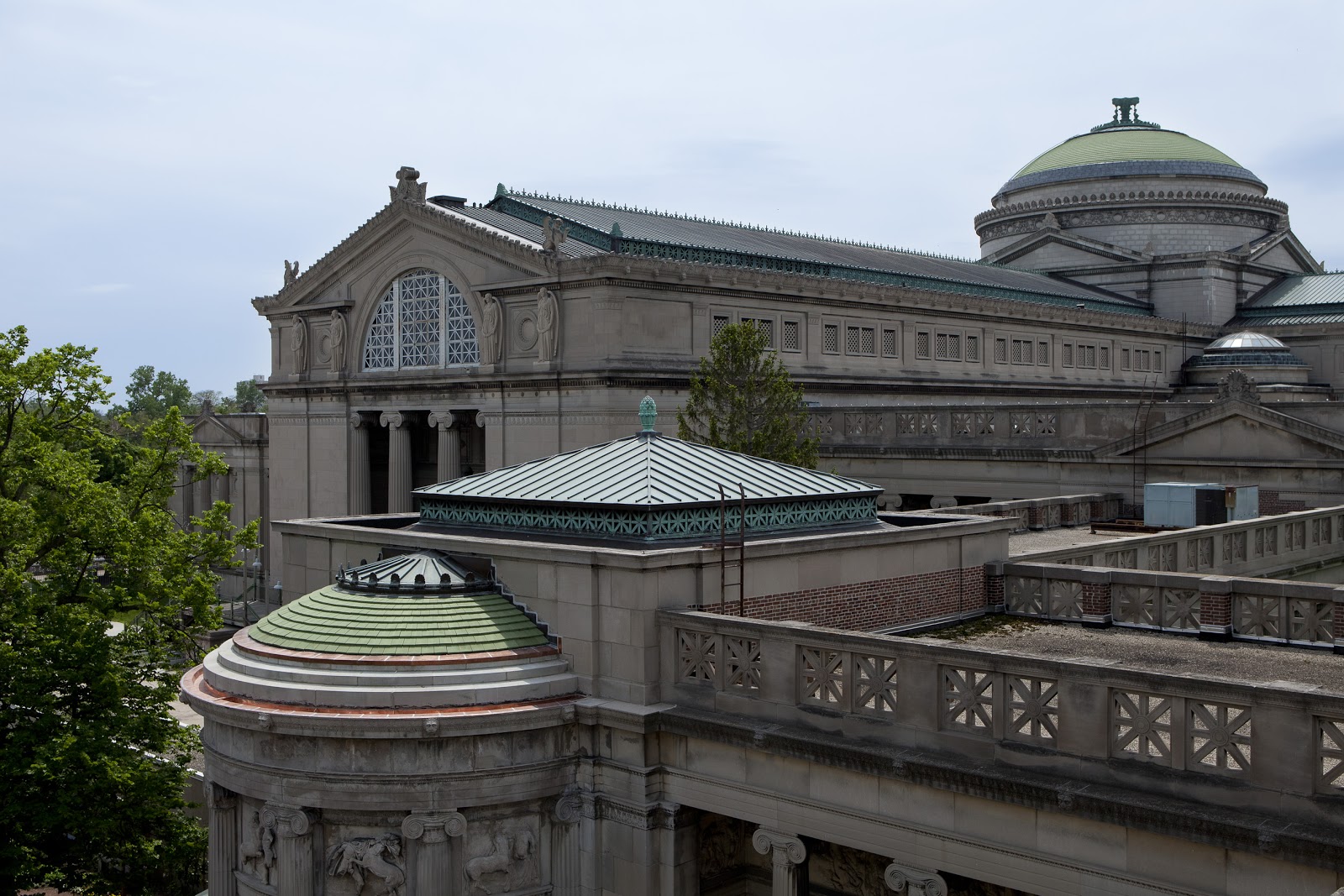
The highly decorative areas of the Museum's East and West Pavilions were
most affected by Chicago's extreme weather.
Photo courtesy of the Museum of Science and Industry, Chicago.

Closeup view of the Museum's East Knuckle rooftop.
Photo courtesy of the Museum of Science and Industry, Chicago.

Notes from the Editor:  There are always special exhibits and events at the Museum of Science and Industry, Chicago but this one particularly interests me:  In 2012, the museum has been celebrating its origins with “The White City… Then and Now.” Offered on special days, it combines a virtual simulation tour of the World’s Columbian Exposition as it would have looked in 1893 with a 25-minute architectural walking tour.

Like many people, my interest in the World’s Columbian Exposition was piqued by Erik Larson’s non-fiction bestseller Devil in the White City. I suspect most readers are lured to the book by the real-life horror story of the serial killer H.H. Holmes. But while that story is undeniably fascinating, it’s easily matched in intensity by the parallel story of Daniel Burnham’s heroic efforts to build the World’s Fair and make it an international success for Chicago. In this rare instance, I thought the hero stole the show from the villain.

Other Important Sites:  Check Chicago’s tourism websites to see if there are any tours of World’s Columbian Exposition locations. While the Museum of Science and Industry provides the best indication of the actual scale and appearance of the White City, other remnants of the fair remain. Daniel Burnham led the effort to build the fair from the 11th floor of the Rookery Building (209 South LaSalle Street), a handsome building that the Burnham and Root firm designed in 1888. Various trees and lagoons in Jackson Park date back to the fair’s original landscaping. The Wooded Isle in Jackson Park was the site of Olmstead’s Japanese Garden. Midway Plaisance, a grassy median that runs through the University of Chicago, served as the main grounds of the fair. Here construction crews recently unearthed the foundations that supported the giant Ferris wheel that was one of the White City’s most famous attractions.

Chicago World's Fair 1893, a chromolithograph by H.D. Nichols,
published by L. Prang and Co. From the collection of the Boston Public Library.
Source:  Wikimedia Commons

Tour America's History Itinerary
Tuesday’s (10/30) destination:  1992 Election Documentary Collection

© 2012 Lee Price

Monday, October 1, 2012

Adlai E. Stevenson Historic Home


View Adlai E. Stevenson Historic Home in a larger map

Visit our Tour Destination: Illinois page to see the entire tour of the state’s Save America’s Treasures sites.

The Adlai E. Stevenson Historic Home.
Jess Smith/PHOTOSMITH.
Photo courtesy of the Lake Country Forest Preserve District

Adlai E. Stevenson Historic Home
St. Mary’s Road between Everett Road and Illinois Route 60
Libertyville, IL


The Treasure:  The Adlai E. Stevenson Historic Home offers insights into the character and legacy of Adlai Stevenson — a popular Illinois governor, a dignified presidential candidate, and a forceful United Nations ambassador.

Accessibility:  The grounds of the Adlai E. Stevenson Historic Home are open daily for self-guided tours from 6:30 a.m. to 5 p.m. There are interpretive signs that offer historical information. Open from April to October, 9 a.m. to 5 p.m., the on-site service building (built in 1937, before Stevenson’s main house was completed) showcases exhibits about Stevenson’s life and career.

Exhibits about Stevenson's life and career.
Jess Smith/PHOTOSMITH.
Photo courtesy of the Lake County Forest Preserve District.

Background:  Whenever presidential elections approach, there’s an inevitable nostalgia for the days when campaigns were more civil. In reality, those times have been rare. For more than two centuries, election seasons have tended to be times of harsh partisan rancor. Perhaps the closest we can come to a golden age of civility would be the 1952 and 1956 contests between Dwight D. Eisenhower and Adlai E. Stevenson II (1900-1965), largely because of Stevenson’s thoughtful and self-deprecating eloquence on the campaign trail.

Adlai and Ellen Stevenson on the Stevenson
"Farm" (the family still calls it this).
Photo courtesy of the Lake County Forest
Preserve District.
Throughout most of his lengthy political career, Stevenson’s home base was his bucolic 70-acre property located near Libertyville, Illinois (in fact, he was promoted as “The Man from Libertyville” during his presidential campaigns). Stevenson and his wife Ellen Borden purchased the property in 1935. After their first house on the property burned down, they tried again in 1938, overseeing the construction of a spacious, art-deco house with large windows, porches, and decks positioned to offer charming views of the landscape. When staying at his home, Stevenson would work for hours in his study, writing books and composing speeches. He entertained many dignitaries here, notably including Eleanor Roosevelt and John F. Kennedy.

Adlai E. Stevenson greets New York Governor
Averell Harriman to his Libertyville home.
Photo courtesy of the Lake County Forest Preserve District.

Although Stevenson never attained the presidency, he worked tirelessly in service to his country, leaving a legacy that touched many facets of American government and political thought. He served as a special attorney within Franklin D. Roosevelt’s Agricultural Adjustment Administration, as a Principal Attorney and special assistant to the Secretary of the Navy, as a special assistant to the Secretary of State, as a governor of Illinois, and as United States Ambassador to the United Nations. Immediately following World War II, he worked with the State Department on the establishment of the United Nations. Under President Kennedy, he famously confronted the Soviets at the United Nations during the Cuban missile crisis.

But Stevenson will probably always be best remembered by the general public as the dignified Democratic candidate for president in 1952 and 1956, always raising the level of political discourse with his intelligence. He was criticized by some for being too aristocratic and intellectual, but very few contenders have ever handled landslide losses with such dignity. A press photograph that showed a hole in the sole of his right shoe became a symbol of his tireless campaigning as well as his frugality. Called an “egghead,” Stevenson responded with a joke: “Eggheads of the world unite, you have nothing to lose but your yolks.” Asked how it felt to lose his 1952 campaign, he paraphrased Abraham Lincoln:  “It hurts too much to laugh, but I’m too old to cry.”

Stevenson had a gift for oratory and an ability to convey an authentic vision of America. His words still inspire:  “There is a new America every morning when we wake up. It is upon us whether we will it or not. The new America is the sum of many small changes — a new subdivision here, a new school there, a new industry where there had been swampland — changes that add up to a broad transformation of our lives. Our task is to guide these changes. For, though change is inevitable, change for the better is a full-time job.”  (Quoted from a presidential campaign address in Miami, Florida, in September 1956.)

Adlai E. Stevenson in his study.
Photo courtesy of the Lake County Forest Preserve District.

Notes from the Editor:  It’s human nature to wonder, “What if…”

In at least three published pieces of fiction, alternative history plots move the Adlai Stevenson story in different and thought-provoking directions. In her 2008 novel Eleanor vs. Ike, Robin Gerber has Eleanor Roosevelt lead the 1952 Democratic ticket after Stevenson suffers a fatal heart attack. In his 2005 science fiction novel Alternities, Michael P. Kube-McDowell imagines a timeline where Adlai Stevenson was elected in 1956 and served two terms. And in his short story “The Impeachment of Adlai Stevenson,” David Gerrold conceives a situation where Stevenson is impeached and resigns in his sixth year in office.

While many pop culture references to Stevenson play on his two-time loser role, others have been more respectful. The popular singer songwriter Sufjan Stevens wrote a charming song about Stevenson that appeared on his 2006 album The Avalanche.


Other Recommended Sites:  The Adlai E. Stevenson Historic Home is located in the Lake Country Forest Preserve District.  Also partially located within the district, the former U.S. Army base Fort Sheridan offers outdoor exhibits about the natural and cultural history of the area. Fort Sheridan functioned as an active military post from 1887 to 1993. The ravines and lakeshore environment of the Fort Sheridan Forest Preserve offer a rare opportunity to glimpse the Lake Michigan landscape in its natural state.

Between the nearby towns of Mundelein and Wauconda, the Lake County Discovery Museum explores local history in a fun learning environment.

Interpretive sign at the Adlai E. Stevenson Historic Home.
Jess Smith/PHOTOSMITH.
Photo courtesy of the Lake County Forest Preserve District.

Tour America's History Itinerary
Friday’s (10/12) destination:  Museum of Science and Industry

© 2012 Lee Price

Thursday, September 27, 2012

The Newberry, Ayer American Indian History Collection


View The Newberry in a larger map

Visit our Tour Destination: Illinois page to see the entire tour of the state’s Save America’s Treasures sites.

Portrait of Abdih-Hiddisch, a Minatarre Chief, by
Karl Bodmer (1809-1893).
Image courtesy of the Newberry.

The Newberry, Edward E. Ayer American Indian History Collection
60 West Walton Street
Chicago, IL

Website:  The Newberry

The Treasure:  Comprising many thousands of rare books, manuscripts, maps, artifacts, paintings, and photographs, the Edward E. Ayer American Indian History Collection at the Newberry is one of the largest and best collections on Native American history in the world.

Accessibility:  A full list of research guides is digitally available for help in navigating the Newberry Library’s collections online. Many objects in the Ayer Collection have been digitized and their images can be found in three online digital collections: the Ayer Art Digital Collection, the Great Lakes Digital Collection, and the North American Indian Photographs Collections. Before visiting Chicago, check the Newberry website for upcoming  exhibitions, programs, and events.

Background:  Edward E. Ayer (1841-1927) donated his major collection of American Indian material to the Newberry Library in 1911. While the Newberry had been in existence for 24 years at that time, it was Ayer’s generous donation that really put the Newberry on the map as one of the country’s leading research institutions. Consisting of more than 17,000 items at the time of the donation, the Ayer Collection offered scholars a bonanza of information pertaining to early contacts between Native Americans and Europeans, as well as important photographic records of the Indians of his time and valuable archaeological information on pre-Columbian Indian cultures.

Equally to his credit, Ayer had the foresight to give the Newberry a significant endowment that has enabled the institution to vastly increase the size of this collection. Slightly over a century later, the collection now contains more than 130,000 volumes, 1 million manuscript pages, 2,000 maps, 500 atlases, 11,000 photographs, and 3,500 drawings and paintings. The Newberry’s D’Arcy McNickle Center for American Indian and Indigenous Studies develops programs and activities to promote use of the collection by scholars, teachers, tribal historians, and others.

With his keen interest in history, Ayer quickly realized the tremendous importance of primary documents. Whenever possible, he acquired the manuscript field notes and drawings of the scientists and explorers who did the pioneering work in recording indigenous cultures. Original manuscripts and drawings by John Howard Payne, Bernardino de Sahagún, Jean-Frederic Waldeck, W.H. Holmes, and E.H. Thompson are among the many treasures in the Ayer Collection.

Artwork from the collection brings the material to life. As one example, the Black Horse Ledger (c. 1874-1878) is a wonderful document of the artistry of the Plains Indians who maintained a tradition of creating visual records of their lives. Originally, they practiced their art on buffalo hides but later adopted the use of paper, such as ledger books obtained from U.S. soldiers, traders, missionaries, and reservation employees.

"Soldiers charging at Powder River" from the Black Horse Ledger
in the Ayer American Indian History Collection at the Newberry.
Image courtesy of the Newberry.

The Black Horse Ledger depicts the lives of Cheyenne warriors, including their interactions with white soldiers and settlers. Drawn by an anonymous Cheyenne warrior (or warriors), the picture above is captioned “Soldiers charging at Powder River,” an 1876 battle. Adding to the complexity of interpretation, the caption may have been added later by one of the ledger’s white owners.

"War party coming home" from the Black Horse Ledger
in the Ayer American Indian History Collection at the Newberry.
Image courtesy of the Newberry.

Also from the Black Horse Ledger, the drawing above depicts Cheyenne warriors on horseback. The artistry of the Plains Indians comes through in their stylized treatment of the horses, colorfully rendered in hues of gold, blue, and green. All 86 pages of the Black Horse Ledger can be viewed at the Plains Indian Ledger Art Project.

Portrait of Pahl-Lee, a young Hopi woman, by
Elbridge Ayer Burbank.
Image courtesy of the Newberry.

It seems appropriate that one of the major art collections within the Ayer Collection showcases the work of Ayer’s nephew, Elbridge Ayer Burbank. Ayer encouraged—and even commissioned—his talented nephew to go west to draw and paint realistic portraits of the Indians. In addition to the painting of a young Hopi woman above, the Newberry holds 1,200 red chalk drawings by Burbank of western and southwestern Indians.

And we haven’t even touched on the photographs, maps, atlases, and material relating to Philippine and Hawaiian history in the Ayer Collection! The collection is truly vast and a remarkable American treasure.

Notes from the Editor:  In 2000, the Newberry received one of the first grants from the Save America’s Treasures program. The funding enabled the Newberry to provide conservation treatment—including media consolidation, paper and parchment stabilization, binding repair, and rehousing—for many fragile items in the Ayer Collection.

Sometimes these opportunities for intensive work result in advancements in the field of conservation. When addressing the needs of seven parchment treaties between the Oneida Nation and the State of New York, the Newberry Conservation Department decided to investigate the range of potential treatments for the deteriorating wax seals on the documents. Through their research and experimentation, they identified the strengths and weaknesses of various consolidants.

While their findings were technical in nature, this type of work is vitally important in determining the best treatment strategies available to conservators engaged in preserving historic documents. The findings of the Newberry Conservation Department were presented and published at the 30th Annual Meeting of the American Institute of Conservation of Historic and Artistic Works, held in 2001.

Other Recommended Sites:  The American Indian Center of Chicago is the principal cultural resource for the many Indians who live in the Chicago metropolitan area. For more than 50 years, they have held a popular annual pow wow. Recently, the American Indian Center of Chicago opened a Trickster Gallery of Native American art in Schaumberg, Illinois.

Without leaving your computer, you can explore a world of information at Native American Cultural Resources on the Internet, a site compiled by web designer Karen Strom building upon the earlier work of Paula Giese.

Entrance to the Newberry.  Photo by Antonio Vernon.
Source:  Wikimedia Commons

Tour America's History Itinerary
Monday’s destination:  Adlai E. Stevenson Historic Home

© 2012 Lee Price


Monday, September 24, 2012

Destination: Illinois


View Chicago in a larger map


View Chicago suburbs in a larger map


View State of Illinois in a larger map


That’s a lot of sites to cover in Illinois!

Above, I’ve placed three maps’ full of Save America’s Treasures sites, each loaded with genuine historical treasure. While there’s an undeniable concentration of sites in the urban northeast of Illinois, I’m pleased that this exploration will eventually take us into nearly every section of the state.

It took me fifty years to get to Illinois for a genuine vacation. Last year, my family and I arrived at Chicago during the annual “Taste of Chicago” event in Grant Park, billed as the world’s largest outdoor food festival. It was a great introduction to a city as renowned for its cuisine as it is for its history and architecture. Naturally, our taste of Chicago included Frank Lloyd Wright homes, the dinosaurs at the Field Museum, Seurat at the Art Insitute of Chicago, and Save America’s Treasures sites, along with the deep dish pizza.

But it’s my hope that our Save America’s Treasures tour will take us beyond Carl Sandburg’s “Hog Butcher for the World/Tool Maker, Stacker of Wheat/Player with Railroads and the Nation's Freight Handler,/Stormy, Husky, Brawling, City of the Big Shoulders.” I’m eager to venture out into the suburbs and great rural expanses of Illinois.

Northern Illinois is the great urban area, where around 80% of the total population lives. Smaller cities—like Peoria, Springfield, Quincy, Decatur, Carbondale, and Marion—dot the central and southern portions of the state. As a part of the country’s interior plains, much of Illinois is flat prairie land. Once you’re out of the cities, the farmland extends for miles and miles.

People have found Illinois to be a welcoming and hospitable land for a long time. The record of human settlement extends way back in time. Archaeological findings at the Koster Site in western Illinois document human activity dating back 7,000 years. Cahokia, located in southern Illinois near St. Louis, Missouri, was the largest Native American city of the Mississippian culture. Not surprisingly, Cahokia has an important Save America’s Treasures site. We’ll be visiting there.

For more professional orientation to Illinois tourism, visit Enjoy Illinois, the official website of the Illinois Office of Tourism.  For more detailed information on Chicago vacation, try Explore Chicago or Chicago Traveler for advice on events, transportation, hotels, and restaurants.

Our Tour America’s History exploration of Illinois’ 32 Save America’s Treasures sites begins on Thursday.

Greetings from Chicago, Illinois!

Tour America's History Itinerary
Thursday’s destination:  Newberry Library, Ayer American Indian Collection

© 2012 Lee Price

Thursday, September 13, 2012

Wadsworth Atheneum Museum of Art


View Wadsworth Atheneum Museum of Art in a larger map

Visit our Tour Destination: Connecticut page to see the entire tour of the state’s Save America’s Treasures sites.

The Wadsworth Atheneum Museum of Art.
Photo courtesy of the Wadsworth Atheneum.

The Wadsworth Atheneum Museum of Art
600 Main Street
Hartford, CT


The Treasure:  The Wadsworth Atheneum was the first public art museum in the United States.  Over 165 years after its founding, it’s still one of the country’s best.

Accessibility:  The Wadsworth Atheneum Museum of Art is open Wednesday, Thursday, and Friday from 11 to 5 and Saturday and Sunday from 10 to 5. On first Thursdays, the museum is open until 8.

Background:  It’s almost as if Daniel Wadsworth (1771-1848) willed the Hudson River School into being. Wadsworth was still a boy when the American Revolution changed the nature of his homeland. Casting their lot with the Patriot cause, his wealthy family successfully navigated the stormy political waters. Everything was in Wadsworth’s favor. As a young man, he had vast wealth, the respect due his family’s service, and a new country to lead into the future.

Wadsworth did become an influential leader, but the degree of his impact upon the country has always been easy to overlook. He didn’t go into politics, and he didn’t become a captain of industry. Instead he traveled much and dabbled in the arts. But he quietly cultivated an important vision—a celebration of his country’s natural landscape as a core part of America’s cultural identity. Wadsworth embraced the emerging European interest in the sublime (artistic representations of the power and vastness of nature) and felt that his nation offered landscapes that could truly capture nature’s grandeur. Unfortunately, he didn’t possess the artistic talent to paint this vision on canvas himself.

When Wadsworth learned that the painter Thomas Cole (1801-1848) was working to capture the American sublime, Wadsworth offered his friendship and his financial patronage. With his backing, Cole painted a series of works that launched the movement that came to be known as the Hudson River School.

Wadsworth’s art collection was eclectic, with European old masters, American historical paintings, and these new contemporary American landscapes. At the age of 70, he announced that he was committed to using his art collection as the core of a new public institution to promote the nation’s culture. Ultimately, Wadsworth hoped to promote a distinctively American culture for a new country—a culture with strong roots in its own native wilderness.

Opened to the public in 1844, the Wadsworth Atheneum has grown enormously over the past century and a half. Thanks to many generous patrons, the museum’s holdings became genuinely encyclopedic—one of the greatest art museums in the country. The collections are strong in contemporary art, surrealism, Old Masters, European and American decorative arts, and, of course, the Hudson River School that Daniel Wadsworth was so influential in nurturing. Today, the Hudson River School collection at the Wadsworth Atheneum includes more than 65 paintings, including works by Thomas Cole, Frederic Edwin Church, Albert Bierstadt, John Frederick Kensett, Sanford Robinson Gifford, Martin Johnson Heade, and Worthington Whittredge.

Thomas Cole
American (born England), 1801-1848
Mount Etna from Taormina, 1843
Oil on canvas
Museum purchase, 1844.6

Notes from the Editor:  When the Wadsworth Atheneum opened in 1844, it enticed the public with its 79 paintings and three sculptures. The collection has grown a bit since then…

Today, the encyclopedic collection is home to more than 50,000 works of art. There are more than 1,000 paintings, 400 sculptures and 4,000 works on paper in the American art collection; about 900 paintings, 500 sculptures, and 3,500 works on paper in the European art collection; and large collections of American and European decorative arts, Colt firearms, and costumes and textiles.

Here’s a brief sampling of some of the museum’s American highlights, selected by the Wadsworth Atheneum Curatorial Department:

Frederic Edwin Church
American, 1826-1900
Vale of St. Thomas, Jamaica, 1867
Oil on canvas
Bequest of Elizabeth Hart Jarvis Colt, 1905.21

Ralph Earl
American, 1751-1801
Oliver Ellsworth and Abigail Wolcott Ellsworth, 1792
Oil on canvas
Gift of the Ellsworth Heirs, 1903.7

Winslow Homer
American, 1836-1910
The Nooning, c. 1872
Oil on canvas
The Ella Gallup Sumner and Mary Catlin Sumner Collection Fund, 1947.1

Fall-Front Desk, c. 1870
American, Madison County, Mississippi
William Howard (c. 1805 - after 1870)
Southern yellow pine, salvaged crate wood, and varnish
The Elijah K. and Barbara A. Hubbard Decorative Arts
Fund, the Evelyn Bonar Storrs Trust Fund,
and the Douglas Tracy Smith and
Dorothy Potter Smith Fund, 2012.2.1

Jazz Bowl, 1931
American, Rocky River, Ohio
Designed by Viktor Schreckengost (1906-2008)
Made at the Cowan Pottery Studio
Glazed earthenware
Gift of Owen and Elizabeth Hedden, 1999.34.1

Other Recommended Sites:  In 1844, the Wadsworth Atheneum building included rooms for the use of the Connecticut Historical Society, the Natural History Society of Hartford, and the Hartford Young Men’s Institute. By 1964, these institutions had moved to new homes.

The Hartford Young Men’s Institute evolved into the Hartford Public Library. In 1892, the library moved from the Wadsworth Atheneum into its first dedicated library building.

The Connecticut Historical Society is one of the state’s most venerable institutions, founded in 1825 and committed to preserving the state’s history. Today, the Connecticut Historical Society offers a library and museum with permanent and changing exhibitions that highlight their significant collections.

East view of the Morgan Memorial at the Wadsworth Atheneum Museum of Art.
Photo courtesy of the Wadsworth Atheneum.

Tour America's History Itinerary
Tuesday’s destination:  Next stop:  Illinois!

© 2012 Lee Price

Thursday, September 6, 2012

Rogers Studio and Museum


View New Canaan Historical Society in a larger map

Visit our Tour Destination: Connecticut page to see the entire tour of the state’s Save America’s Treasures sites.

The John Rogers Studio.
Photo courtesy of the New Canaan Historical Society.

New Canaan Historical Society, Rogers Studio and Museum
13 Oenoke Ridge Road
New CanaanCT

  
The Treasure:  Maintained by the New Canaan Historical Society, the John Rogers Studio and Museum preserves the working environment of a beloved artist of the mid- to late 19th century.

Accessibility:  The New Canaan Historical Society is open Tuesdays through Fridays from 9:30 to 4:30 and Saturdays from 9:30 to 12:30. Tours of the John Rogers Studio are by appointment only. Contact the New Canaan Historical Society to make an appointment!

Background:  Marble and brass sculptures were enormously popular in the 19th century.  Cities and towns, businesses, and the wealthiest citizens often bought or commissioned statues from the period’s most eminent sculptors. But these sculptures were out of reach for most households.

John Rogers in 1904.
Source:  Wikimedia Commons
John Rogers (1829-1904) had dreams of being a famous sculptor but realized early on that he would be unable to compete with the academically-trained artists who routinely received the major commissions. Employed by the city of Chicago, he sculpted smaller figures in clay as a hobby. At the age of 30, his sculpture “The Checker Players” proved popular at a local charity fair and then his follow-up, a “Slave Auction” piece, gained attention at an exhibit in New YorkRogers quit his job to be a sculptor—but a different kind of sculptor than the ones who received the prestigious jobs and the critical accolades.

Rogers astutely targeted the emerging middle class. Working in the relatively inexpensive medium of painted plaster, he realized that he could create attractive parlor pieces that could retail for $15 or even a little less. While this was a significant sum for a middle class family, it placed attractive sculpture within their reach. For his subjects, Rogers naturally gravitated toward patriotic, sentimental, and comic themes entirely in keeping with the popular tastes of his day.

Over a nearly 35-year career, Rogers sculpted 86 different scenes (popularly known as “Rogers Groups”), most of them suggesting a short simple-to-understand story—in much the same folksy way as the later Norman Rockwell paintings. He gained fame and popularity with his Civil War groups sculpted during the war, and then moved on to homespun pieces with names like “Weighing the Baby,” “Neighboring Pews,” “The Traveling Magician,” and “The Checker Players.” His all-time bestseller was “Coming to the Parson,” produced in 1870, which sold approximately 8,000 copies over twenty years.

A selection of Rogers Groups at the John Rogers Studio and Museum.
Photo courtesy of the New Canaan Historical Society.

Notes from the Editor:  John Rogers understood the product he was selling and the audience that he intended it for. In his words, he aimed to capture “the little moments in life, humorous and sentimental, events which make up a lifetime.” He steadfastly maintained, “Home scenes interest everybody.”

Even though life has changed enormously in the past 125 years, the little stories of Rogers’ sculptures remain instantly identifiable—and retain their charm as well.

First offered by Rogers in 1870, "Coming to the Parson" was
his most popular piece, selling approximately 8,000 copies.
Source:  Wikimedia Commons

"Checkers on the Farm," a Rogers Group from 1875.  Here's a
link to a video celebration of this particular piece, courtesy
of the New-York Historical Society.
Source:  Wikimedia Commons

"Weighing the Baby," a popular Rogers Group from 1876.
Source:  Wikimedia Commons

Other Recommended Sites:  The John Rogers Studio is one of two National Historic Landmarks in New Canaan. The other National Historic Landmark is the Glass House, architect Philip Johnson’s iconic declaration of International Style principles. As its name indicates, it is a house made of glass, with no interior walls to block the view. The effect from inside the pavilion is to create a serene center to contemplate the surrounding landscape. The National Trust for Historic Preservation maintains the Glass House and the other Johnson architectural structures on the property, using them to interpret modern architecture, landscape, and art.

A corner of the Rogers Studio and Museum, decorated with his Rogers Groups.
Photo courtesy of the New Canaan Historical Society.

Tour America's History Itinerary
Wednesday’s destination:  Wadsworth Atheneum

© 2012 Lee Price


Monday, August 27, 2012

Mark Twain House and Museum


View Mark Twain House and Museum in a larger map

Visit our Tour Destination: Connecticut page to see the entire tour of the state’s Save America’s Treasures sites.

The Mark Twain House in Hartford, CT.
Credit:  John Groo for The Mark Twain House & Museum.

The Mark Twain House & Museum
351 Farmington Avenue
Hartford, CT

  
The Treasure:  This is the house where Mark Twain wrote Adventures of Huckleberry Finn—and lots more, too.

Accessibility:  For most of the year, the Mark Twain House and Museum is open Monday through Saturday from 9:30 to 5:30 and Sunday from noon to 5:30.  From January through March, the site is closed on Tuesdays.

Mark Twain in 1907.
Image courtesy of The Mark Twain
House & Museum.
Background:  Samuel Clemens, better known by his pseudonym Mark Twain, moved into his Hartford home along with his wife Olivia “Livy” Clemens in 1874 and remained there until 1891. It was to be the happiest and most productive period of the sharp-tongued author’s life. While ensconced in his private study on the top floor, he wrote and published The Adventures of Tom Sawyer, Life on the Mississippi, The Prince and the Pauper, A Connecticut Yankee in King Arthur’s Court, and (perhaps most famously) Adventures of Huckleberry Finn.

For a total of 17 years, this house served as home to the author, his wife Livy, and their three daughters. During that time, Twain’s taste for new technology quietly altered the space, including the introduction of an early telephone in the kitchen. Of all the places he lived during his life, this one was certainly his favorite.

The couple engaged New York architect Edward Tuckerman Potter to design an ambitiously large house which they paid for with Twain’s earnings from his books as well as Livy’s significant inheritance. The house follows a Victorian Gothic Revival architectural style, including a steeply-pitched roof and an asymmetrical bay window. At the time of its completion, the house cost between $40,000 to $45,000 dollars—a considerable sum for the time. Still, Twain didn’t mind. According to him, his Hartford house was “a home, and the word never had so much meaning before.”

The Mark Twain House -- the Clemens family on the porch.
Photo courtesy of The Mark Twain House & Museum.
                                                                                                                             
Notes from the Editor:  Mark Twain is a favorite author of mine to the degree that one of my most frequently-worn shirts bears a quote of his: “Those who don’t read have no advantage over those who can’t.” His genius found no subject too sacred to comment upon, and his own words remain the best way to capture his personality.

Here are some of my favorite Mark Twain quotes:

“It were not best that we should all think alike; it is difference of opinion that makes horse-races.”

“Life does not consist mainly—or even largely—of facts and happenings. It consists mainly of the storm of thoughts that is forever blowing through one's head.”

“There is a charm about the forbidden that makes it unspeakably desirable.”

Twain thought quite a bit about how “thinking” itself works, and he questioned everything. His incisively witty descriptions of his 19th century surroundings invariably succeeded in capturing distinct times and places while reflecting universal truths. As he once pointed out, the call of “Mark Twain” on a steamboat was one that could always be relied upon—and he upheld that same standard in his writings.

The Mark Twain House -- The Dining Room.
Credit:  John Groo for The Mark Twain House & Museum.

The Mark Twain House -- The Billiard Room.
Credit:  John Groo for The Mark Twain House & Museum.

Other Recommended Sites:  The Mark Twain Library in Redding, CT takes pride in its roots in Twain’s generosity. He was one of the founders of the library and donated a large collection of books to start them out. There are artifacts associated with Twain in the library and notable Twain quotes line the walls.

Mark Twain grew up on the banks of the Mississippi River in Hannibal, Missouri, where you can visit the Mark Twain Boyhood Home & Museum, explore the river on a Mark Twain Riverboat, and descend into the Mark Twain Cave Complex that inspired the memorable climax of The Adventures of Tom Sawyer.

The Mark Twain Museum Center.
Credit:  John Groo for The Mark Twain House & Museum.

Guest author for this entry:  Terry Price

Tour America's History Itinerary
Thursday’s (9/6) destination:  New Canaan Historical Society

© 2012 Lee and Terry Price