Tour America's Treasures


An invitation to tour America's historical sites...

Friday, November 30, 2012

The Carl Sandburg Collection


View University of Illinois at Urbana-Champaign in a larger map

Visit our Tour Destination: Illinois page to see the entire tour of the state’s
Save America’s Treasures sites.


A selection of items from the Carl Sandburg Collection.
Photo courtesy of the University of Illinois at Urbana-Champaign.

The Carl Sandburg Collection
Rare Book and Manuscript Library
University Library
University of Illinois at Urbana-Champaign
1408 West Gregory Drive
Urbana, IL


The Treasure:   The country’s most comprehensive collection of Sandburg materials, the Carl Sandburg Collection includes literary manuscripts, correspondence, photographs, newspaper clippings, audiovisual materials, and thousands of books.

Accessibility:  Researchers must register with the library before they may gain access to requested material. The Rare Book and Manuscript Library is open Monday through Friday from 8:30 to 5. There’s usually a changing exhibit highlighting material from the library’s special collections.

Background:  The honors poured in near the end of Carl Sandburg’s long life (1878-1967). On February 12, 1959, the 150th anniversary of the birth of Abraham Lincoln, Sandburg addressed a special joint session of Congress on the legacy of the president whom he had celebrated in the acclaimed biography Lincoln: The Prairie Years (two volumes) and the Pulitzer Prize-winning Lincoln: The War Years (four more volumes). In a rare honor for a private citizen, Sandburg spoke before both houses of Congress, offering a dignified and eloquent tribute to Lincoln. Here’s a brief snippet of Sandburg speaking that day:


But that probably wasn’t Sandburg’s favorite honor. By many accounts, he was particularly proud of the Silver Plaque Award that he received from the National Association for the Advancement of Colored People (NAACP) in 1965. This award recognized the importance of his years of work as an investigative reporter covering race relations in Chicago. During the extremely difficult times of the 1919 Chicago race riots, Sandburg drew upon his connections within the black community to honestly describe the root causes of frustration and anger. As with all the causes that he championed, Sandburg always stood on the side of working men, women, and children, with singular empathy for the country’s most vulnerable citizens.

Sandburg received a Grammy Award, too.  In 1959, he won a Grammy for “Best Performance – Documentary or Spoken Word” for his collaboration with the New York Philharmonic on Aaron Copland’s Lincoln Portrait. This honor tied in nicely with his other longstanding musical achievement—he was one of the first people to attempt to document and compile American folk songs. His 1927 publication The American Songbag has been hailed by legendary folk singer Pete Seeger as a “landmark” work in the field.

But, above all, Sandburg was a poet. In his poetry, he pulled together all these threads—his love of history, his profound feelings for social justice, and his delight in the common vernacular and the music of the people—to express a singularly American vision.

THEY WILL SAY

     OF my city the worst that men will ever say is this:
You took little children away from the sun and the dew,
And the glimmers that played in the grass under the great sky,
And the reckless rain; you put them between walls
To work, broken and smothered, for bread and wages,
To eat dust in their throats and die empty-hearted
For a little handful of pay on a few Saturday nights.

Carl Sandburg
from Chicago Poems (1916)

At the University of Illinois at Urbana-Champaign, the University Library’s preservation program led the large-scale project to ensure long-term preservation of the Carl Sandburg Collection. The work included mass deacidification, item-level deacidification, preservation photocopying, encapsulation, and conservation treatments. Audiovisual materials were reformatted digitally and in analog form.

A view of three of the many iterations of Sandburg's poem, The People, Yes.
Photo courtesy of the University of Illinois at Urbana-Champaign.

Other Recommended Sites:  There are two other major Sandburg historic sites to visit. The Carl Sandburg Birthplace and Visitor Center in Galesburg, Illinois preserves the historic house and provides plenty of background information at a neighboring museum and theater. In Connemara, North Carolina, the Carl Sandburg Home National Historic Site showcases the 264-acre farm where Sandburg settled down for the final 22 years of his life.

Carl Sandburg.
Source: Wikimedia Commons

Tour America's History Itinerary
Thursday’s destination:  Riverside Water Tower

© 2012 Lee Price

Monday, November 26, 2012

Glessner House Museum


View Glessner House Museum in a larger map

Visit our Tour Destination: Illinois page to see the entire tour of the state’s
Save America’s Treasures sites.

Exterior of the Glessner House Museum.
Photo courtesy of the Glessner House Museum.

Glessner House Museum
1800 South Prairie Avenue
Chicago, IL


The Treasure:   Both an architectural masterpiece and an important Arts and Crafts destination, Glessner House offers a fascinating glimpse into upper-class life in Chicago during America’s Gilded Age.

Accessibility:  The Glessner House Museum is open year-round, with tours offered Wednesday through Saturday at 1 and 3 p.m.

Background:  Built in the mid-1880s on Chicago’s very fashionable Prairie Avenue, Glessner House was initially viewed askance by its more traditional neighbors. While John J. Glessner (1843-1936) was well respected as an up-and-coming member of Chicago society, his house was… different. It reflected the new English fashion for medievalism. And it even asserted the Glessners’ privacy by offering few exterior windows for the neighbors to observe them through. One of these neighbors was George Pullman, the industrialist behind the Pullman sleeping car. Apparently, Pullman never adjusted to the sight of the Glessner House, once saying, “I do not know what I have ever done to have that thing staring me in the face every time I go out of my door.”

Having made his fortune in the farm implement trade (managing one of the five companies that would eventually form International Harvester), Glessner commissioned one of the country’s most famous architects, Henry Hobson (H.H.) Richardson (1838-1886), who had nationally established himself with the monumental design of Boston’s Trinity Church in 1872. With buildings like Trinity Church, Richardson’s style was so distinctive that it became known by his name: “Richardsonian Romanesque.” He built libraries, railroad stations, public buildings, commercial buildings, college halls, and family homes in this new style. The Richardsonian Romanesque style freely adapted medieval inspirations, mainly derived from 11th and 12th century France, using modern engineering and American materials.

The Main Hall at the Glessner House Museum.
Photo courtesy of the Glessner House Museum.
Glessner House is widely acknowledged to be Richardson’s masterpiece of urban residential design. It truly did look different from the other staid townhouses of Prairie Avenue. The house’s exterior was built of imposing Braggville pink granite, creating a medieval fortress-like effect. The exterior ornamentation was kept to a stark minimum. But in its interior, Glessner House offered a cozy domestic feeling appropriate for raising a family. The casual mix of small and larger rooms often featured welcoming fireplaces and colorful Arts and Crafts Movement details.

The Library at the Glessner House Museum.
Photo courtesy of the Glessner House Museum.
Along with their chosen architect, Glessner and his wife Frances shared a love of the flourishing English Arts and Crafts Movement. The Glessners and Richardson appreciated the works of John Ruskin, an influential English writer who called for a societal revival of the artistry and craftsmanship of medieval times. In decorating the house, the Glessners looked to William Morris and other Arts and Crafts practitioners — all of whom were also inspired by Ruskin’s ideas. In the decades that followed the building of Glessner House, the Arts and Crafts movement would explode in the United States with Chicago serving as a major hub for the new breed of craftsmen, artists, and architects. Frank Lloyd Wright’s famous Prairie Style was profoundly influenced by these new ideas, both in architecture and design.

There is much to interpret today at Glessner House. People come to see its formidable architecture and its beautiful Arts and Crafts collections (with notable works by William Morris, Louis Comfort Tiffany, Isaac Scott, Emile GallĂ©, and Francis Bacon). However, they probably mostly come to enjoy a tantalizing glimpse of life in the Gilded Age. The Glessners combined wealth with intelligence and taste, creating an enclosed world on Prairie Street that reveals the uniquely 19th century aspirations of the Gilded Age.

The Dining Room at Glessner House Museum.
Photo courtesy of Glessner House Museum.

The Parlor at Glessner House Museum.
Photo courtesy of Glessner House Museum.

The Save America's Treasures project at Glessner House Museum involved
the restoration/renovation of the original coach house, which originally
contained the carriage house and stable.
Photo courtesy of the Glessner House Museum.

Other Recommended Sites:  The Glessner House Museum also offers tours of Clarke House Museum (1827 S. Indiana Avenue), just around the corner from Glessner House. Completed in 1836, the Clarke House Museum is Chicago’s oldest surviving building. Seasonal neighborhood tours take visitors past other notable Prairie Avenue locations, including the Second Presbyterian Church. Located at 1936 S. Michigan Avenue, Second Presbyterian Church contains one of the largest and most intact Arts and Crafts interiors in the country including nine Tiffany windows and two others that were designed by Sir Edward Burne-Jones for Morris & Co., the influential English business established by William Morris. The Second Presbyterian Church offers interior guided tours, as well as a self-guided tour brochure.

A spacious private courtyard at Glessner House provided natural light
for the main rooms of the house, while retaining the family's privacy.
Photo courtesy of the Glessner House Museum

Tour America's History Itinerary
Friday’s destination:  The Carl Sandburg Collection

© 2012 Lee Price

Friday, November 16, 2012

Carlson Cottage at Lincoln Park Zoo


View Carlson Cottage in a larger map

Visit our Tour Destination: Illinois page to see the entire tour of the state’s Save America’s Treasures sites.

Carlson Cottage at Lincoln Park Zoo.
Photo courtesy of Lincoln Park Zoo.

Carlson Cottage
Lincoln Park Zoo
2001 North Clark Street
Chicago, IL

Website:  Lincoln Park Zoo

The Treasure:  One of the oldest buildings in Lincoln Park, Carlson Cottage is a picturesque survivor of Victorian-era Chicago.

Accessibility:  The exterior of Carlson Cottage can be viewed every day at Lincoln Park Zoo, where it can be found near the historic CafĂ© Brauer.

Background:  With its charming architecture, its prime location in Lincoln Park, and even a tantalizing whiff of violence to flavor its past, Carlson Cottage is a small yet potent reminder of Chicago’s colorful past and undeniable ambition. This is a city where even the public restrooms can be architectural gems, resonating with stories!

Today, Carlson Cottage is a part of Chicago’s famous Lincoln Park Zoo. The zoo came first, starting small with the 1868 donation of a pair of swans from New York City’s Central Park. Two decades later, the zoo’s first director, Cyrus DeVry, was hired. And in that same year (1888), Carlson Cottage was built.

The historic restoration of Carlson Cottage was led by
preservation architect Paul Steinbrecher of
InterActive Design, Inc. in 2008.
Photo courtesy of Lincoln Park Zoo. 
The first public restroom facility in Lincoln Park, Carlson Cottage has a delightful Victorian design, courtesy of notable Chicago architect Joseph Lyman Silsbee. This was a relatively minor commission for Silsbee, an architect who often worked on much grander projects — such as the Lincoln Park Conservatory — and served as a mentor to up-and-coming architects Frank Lloyd Wright, George Maher, and George Elmslie. Known simply as a Comfort Station in its early years, Carlson Cottage was constructed of brick and stone and capped with an attractive cedar shingle roof.

The restroom function of Carlson Cottage was abandoned long ago. In 1995, Lincoln Park Zoo began using the building as a center for its volunteer gardening program. Coinciding with the Save America’s Treasures restoration in 2008, the volunteers planted new gardens around Carlson Cottage to reinforce an appropriate late 19th-century ambience.

As for the whiff of violence mentioned above, here’s all we know:  During the restoration, a rusty 19th century pistol was discovered in a plumbing vent pipe. That’s not much to go on, but it’s sufficient to summon up an image of the Chicago underworld, already a potent force in the 1880s, dominated by shady figures like John “Mushmouth” Johnson and Giovanni “Johnny” Torrio. Unfortunately, imagination must take over at this point. With only a single artifact to go by, it’s highly unlikely that the real story behind the abandoned gun will ever come to light.

Other Recommended Sites:  For another impressive building by the architect of Carlson Cottage, visit the nearby Lincoln Park Conservatory which Joseph Lyman Silsbee designed in collaboration with fellow Chicago architect Mifflin E. Bell.  A docent program jointly sponsored by the Chicago Park District and the Lincoln Park Conservancy offers  free tours of the historic building and its important horticultural collections on weekends.

An 1888 historic engraving of Carlson Cottage by architect George Maher
provided significant information regarding the original appearance of the building.
Photo courtesy of Lincoln Park Zoo.

Tour America's History Itinerary
Monday’s (11/26) destination:  Glessner House Museum

© 2012 Lee Price

Monday, November 12, 2012

Bishop Hill Steeple Building


View Bishop Hill Steeple Building in a larger map

Visit our Tour Destination: Illinois page to see the entire tour of the state’s Save America’s Treasures sites.

The Steeple Building in winter 2011.
Photo courtesy of the Bishop Hill Heritage Association.

Bishop Hill Steeple Building
Bishop Hill Street and East Main Street
Bishop Hill, IL


The Treasure:  The Steeple Building is the most impressive of the town’s surviving structures that tell the story of the Bishop Hill Colony, a mid-19th century utopian community.

Accessibility:  Visit the archives and museum of the Bishop Hill Heritage Association within the Steeple Building.  Check their website for current hours.

The Bishop Hill Steeple Building reflected
in the Colony Store window.
Photo courtesy of the
Bishop Hill Heritage Association.
Background:  Faced with the vast and beautiful lands of the New World, visionary religious thinkers were inspired to find links between the Bible’s prophecies of a New Jerusalem and the American landscape. The Puritans were inspired by the promise of the New Jerusalem, some Quaker leaders spoke of the New Jerusalem, and visions of the New Jerusalem were a key part of the revelation of Joseph Smith in the founding documents of the Church of Jesus Christ of Latter-Day Saints.

Born in Sweden in 1808, Eric Jansson was inspired by his own vision of a New Jerusalem waiting to be founded in the far-away land of the United States. While still a young man, he rebelled against the teachings of the Lutheran Church and called his followers to accompany him to found a new community in America’s Midwest. Approximately 1,200 of Jansson’s countrymen followed him on his trek half-way across the world. They sailed to New York then up the Hudson River, taking the Erie Canal to Buffalo and then across the Great Lakes to the western shore of Lake Michigan. Following a route recommended by a Swedish Methodist minister in New York, Jansson and his followers journeyed inland, staking their claim approximately 100 miles west of Chicago.

Life in the new Bishop Hill settlement was harsh during the first two years, with the settlers occupying 12 large dugouts where they lived in cramped, cold quarters. But the Janssonists—as they were called—persevered, dutifully accepting Jansson’s leadership and vision. Embracing hard work and a communitarian philosophy, they realized a fair degree of prosperity within five years. They built impressive dormitory living quarters, a church, a flour mill, two saw mills, a hotel, a colony store and post office, a school, and the Steeple Building (constructed in 1854).

The Bishop Hill Steeple Building, circa 1900.
Photo courtesy of the Bishop Hill Heritage Association.
But as with many radical 19th century experiments in utopian living, the Bishop Hill Colony fell as quickly as it rose. Eric Jansson was fatally shot by the disgruntled husband of one of his followers in May 1850. Power struggles ensued. For eleven years following Jansson’s murder, the Bishop Hill Colony struggled to remain true to the original calling to build the New Jerusalem in central Illinois—but without Jansson, it wasn’t possible. In 1861, the Bishop Hill Colony was formally dissolved and the communally-held land was evenly distributed among its members.

Today serving as home to the museum and archive of the Bishop Hill Heritage Association, the Steeple Building recalls the optimism of settlers creating community even as they faced enormous challenges. Built of brick and stucco, the Steeple Building’s prominent feature is a handsome clock tower with four clock faces, each keeping time with only a single hand. Originally intended to serve as a hotel, the Steeple Building was instead used over the years as a dormitory living quarters, a school, an administration building, a bank, a telephone office, and an apartment building complex.

A plaque at the Pioneer Monument at Bishop Hill reads:  “Dedicated to the memory of the hardy pioneers who in order to secure religious liberty left Sweden their native land with all the endearments of home and kindred and found Bishop Hill Colony on the uninhabited prairies of Illinois.”

Restoration work underway at the Steeple Building in 2012.
Photo courtesy of the Bishop Hill Heritage Association.

Restoration work at the Steeple Building.
Photo courtesy of the Bishop Hill Heritage Association.

Restoration work underway at the Steeple Building.
Photo courtesy of the Bishop Hill Heritage Association.

Other Recommended Sites:  The Bishop Hill Heritage Association works with the Illinois Historic Preservation Agency to keep the historic structures of the Bishop Hill Colony accessible to the public. Check the website for information on tours of the Colony Church and Bjorklund Hotel. The Henry County Historical Museum can introduce the rest of the history of the area (it’s not all Janssonists!) and the Vasa National Archives has a special emphasis on the Swedish-American heritage that shaped the region. Information on local organizations, businesses, and upcoming events can be found at the Bishop Hill, Illinois website.

The distinctive clock tower on the Bishop Hill Steeple Building.
Photo courtesy of the Bishop Hill Heritage Association.

Tour America's History Itinerary
Friday’s destination:  Carlson Cottage

© 2012 Lee Price

Friday, November 9, 2012

Jens Jensen Park


View Jens Jensen Park in a larger map

Visit our Tour Destination: Illinois page to see the entire tour of the state’s Save America’s Treasures sites.

The council ring at Jens Jensen Park, designed by landscape architect
Jens Jensen.  Photo by Bob Laemle.

Jens Jensen Park
540 Roger Williams Avenue
Highland Park, IL

The Treasure:  The vision of influential landscape architect Jens Jensen is beautifully expressed by this very faithful restoration of a park he designed for his hometown.

Accessibility:  Relax in the park whenever you’re in the neighborhood!

Background:  “The art of landscaping is that of a fleeting thought that must be caught on the wing.”  Jens Jensen (1860-1951)

Jens Jensen was a Danish immigrant who worked himself up from a job as a street sweeper for the Chicago West Parks District to superintendent of the Chicago Parks Commission. Influenced both by famed landscape architect Frederick Law Olmstead (designer of New York City’s Central Park) and visionary architect Frank Lloyd Wright, Jensen brought many of the ideas of Wright’s Prairie Style to bear on his designs for parkland and estate grounds. He embraced the native plants and trees of the Midwest, creating parks in harmony with the original natural landscape of the area.

Jensen's plan for the park.
Built within a triangle formed by three roads, Jens Jensen Park accomplishes much within a fairly small area. Jensen loved meadows, so he planned for two adjacent meadow areas, each ringed by native trees. Naturally, the park contains one of his trademark features, a council ring. Inspired by his respect for Native American circles, Jensen envisioned his council rings as areas where neighbors could gather and exchange ideas, quietly appreciate nature, or even stage theatrical productions. In the center of the Jens Jensen Park council ring, he designed a circular lily pond centered on a handsome rough-hewn granite boulder.

Landscape architecture is notoriously short-lived. Many of Jensen’s parks are no longer recognizably his work. Thanks to the 2005-2007 restoration led by landscape architects Nick and Amy Patera of Teska Associates, you can still experience the authentic vision of Jens Jensen in Highland Park.

Before:  The council ring at Jens Jensen Park before the restoration.

After:  The council ring at Jens Jensen Park after the restoration.
Photo by Bob Laemle.

New benches in the restored Jens Jensen Park.
Photo by Bob Laemle.

Other Recommended Sites:  Jensen’s home and studio are located just a few blocks away at 950 Dean Avenue. Although they are not open to the public, you can pass by to pay homage to his work and influence. In addition to being the home of Jens Jensen for many years, Highland Park is also notable for houses designed by some of Chicago’s greatest architects, including Frank Lloyd Wright, John S. Van Bergen, Howard Van Doren Shaw, and David Adler. Architectural Resources in Highland Park, Illinois is a detailed PDF document that provides a thorough background on the varied, and often masterful, architecture of Highland Park.

A new sign for the restored Jens Jensen Park in Highland Park.
Photo by Bob Laemle.

Tour America's History Itinerary
Monday’s destination:  Bishop Hill Steeple Building

© 2012 Lee Price

Wednesday, October 31, 2012

1992 Election Documentary Collection


Visit our Tour Destination: Illinois page to see the entire tour of the state’s Save America’s Treasures sites.

Bill Clinton at church in 1992.
Video still from the 1992 Election Documentary Collection,
Media Burn Independent Video Archive.

1992 Election Documentary Collection
Media Burn Independent Video Archives


The Treasure:  Footage of Bill Clinton, George H.W. Bush, H. Ross Perot, Hillary Clinton, Al Gore, James Carville, Rahm Emanuel, Dee Dee Myers, George Stephanopoulos, David Axelrod, Jerry Brown, Paul Tsongas, and Carol Moseley Brown in the midst of the 1992 campaigns, with everyone jockeying for positions of influence in the high stakes world of American electoral politics.

Accessibility:  These tapes must be among the most accessible of all Save America’s Treasures projects! All 120 project videotapes can be easily accessed at the Media Burn Independent Video Archive. They’re just a couple of clicks away…

Background:  In preparation for a three-part national PBS series called The 90’s, independent producers fanned out from Chicago to videotape the 1992 presidential campaign. It was a season filled with surprises. The Democratic primaries remained a toss-up until Super Tuesday when then-governor Bill Clinton finally seized the lead. Then after the conventions, the path to the presidency proved unusually complex because of the on-again, off-again candidacy of H. Ross Perot.

Rahm Emanuel during the 1992 campaign.
Video still from the Media Burn Archive.
Tom Weinberg, founder of Media Burn and an executive producer of The 90’s, was one of the cameramen who worked on the project. Years later, he recalled: “When a few dozen of us independent videomakers were shooting these tapes in 1992, we knew it was unique and important — something that could not have been possible at any other moment in history.”

The cameramen who followed the early days of the Clinton campaign received unusually close access to Clinton’s strategic team, allowing close-up behind-the-scenes glimpses of a campaign poised to make history. Their footage captures early political use of the internet and e-mail as part of Clinton’s cutting-edge strategies.

George Stephanopolous in 1992.
Video still from the Media Burn Archive.
The Media Burn Archive preserves much more than just the 1992 Election Documentary Collection. After you finish watching the 450 hours of election footage, you can move on to enjoy more than 1,000 hours of other historic video treats, all streaming free of charge. Media Burn preserves over 6,000 videotapes covering the years from 1969 to the present, celebrating Chicago’s musicians, politicians, sports legends, radio personalities, community leaders, and neighborhood festivals. Special attention is paid to Media Burn’s inspiration, Chicago legend Studs Terkel who spent his life documenting the life of the city.

Hillary Clinton during the 1992 campaign.
Video still from the Media Burn Independent Video Archive.

Notes from the Editor:  CNN became a powerhouse in 1991 with its Gulf War coverage, establishing a demand for the 24-hour news cycle. As the presidential campaign heated up, cameras were everywhere, filming everything. So what happened to all the footage?

Much of the documentary videotape has been lost due to natural deterioration. The videotapes used by news teams in the early 1990s were designed for immediate use, with little to no thought given to long-term archival preservation. The filmmakers employed in the production of The 90’s used a new Hi-8mm format that turned out to be highly susceptible to corrosion problems. The tapes began to lose detail almost immediately. As producers moved to newer formats, the playback machines that supported the older formats were neglected or discarded. Soon the old tapes were deteriorating and there were no machines to even play them on.

The Media Burn 1992 Election Documentary Collection dwarfs all other surviving collections of this pivotal period. It preserves more than 450 hours of footage from the campaigns. The only other major source of behind-the-scenes 1992 campaign footage — the video shot by documentary film producer D.A. Pennebaker for The War Room (1993) — constitutes just 35 hours of material. Taken together, these two collections preserve an extraordinary record of an important time.

Considering the extreme inaccessibility of this material at the time when the Save America’s Treasures award was announced in 2009, we are indeed lucky to be able to so easily access, study, and enjoy these films today — simply by visiting a website and streaming the videos.

Original Hi-8mm videotape from the 1992 Election Documentary Collection
in storage at Media Burn Independent Video Archive.

Other Recommended Sites:  In the summer of 2012, Chicago’s Museum of Broadcast Communications re-opened in a handsome— and very green — building. The country’s national Radio Hall of Fame is located there. The Video Databank in downtown Chicago allows free in-person viewing of its video art collection. While the Chicago Film Archives does not have facilities for public on-site access, they are working to digitize their collections in order to increase their accessibility.

Bill and Hillary Clinton celebrate his Illinois primary victory in 1992.
Video still from the Media Burn Independent Video Archive.

Tour America's History Itinerary
Friday’s (11/9) destination:  Jens Jensen Park

© 2012 Lee Price 


Friday, October 12, 2012

Museum of Science and Industry, Chicago


Visit our Tour Destination: Illinois page to see the entire tour of the state’s Save America’s Treasures sites.

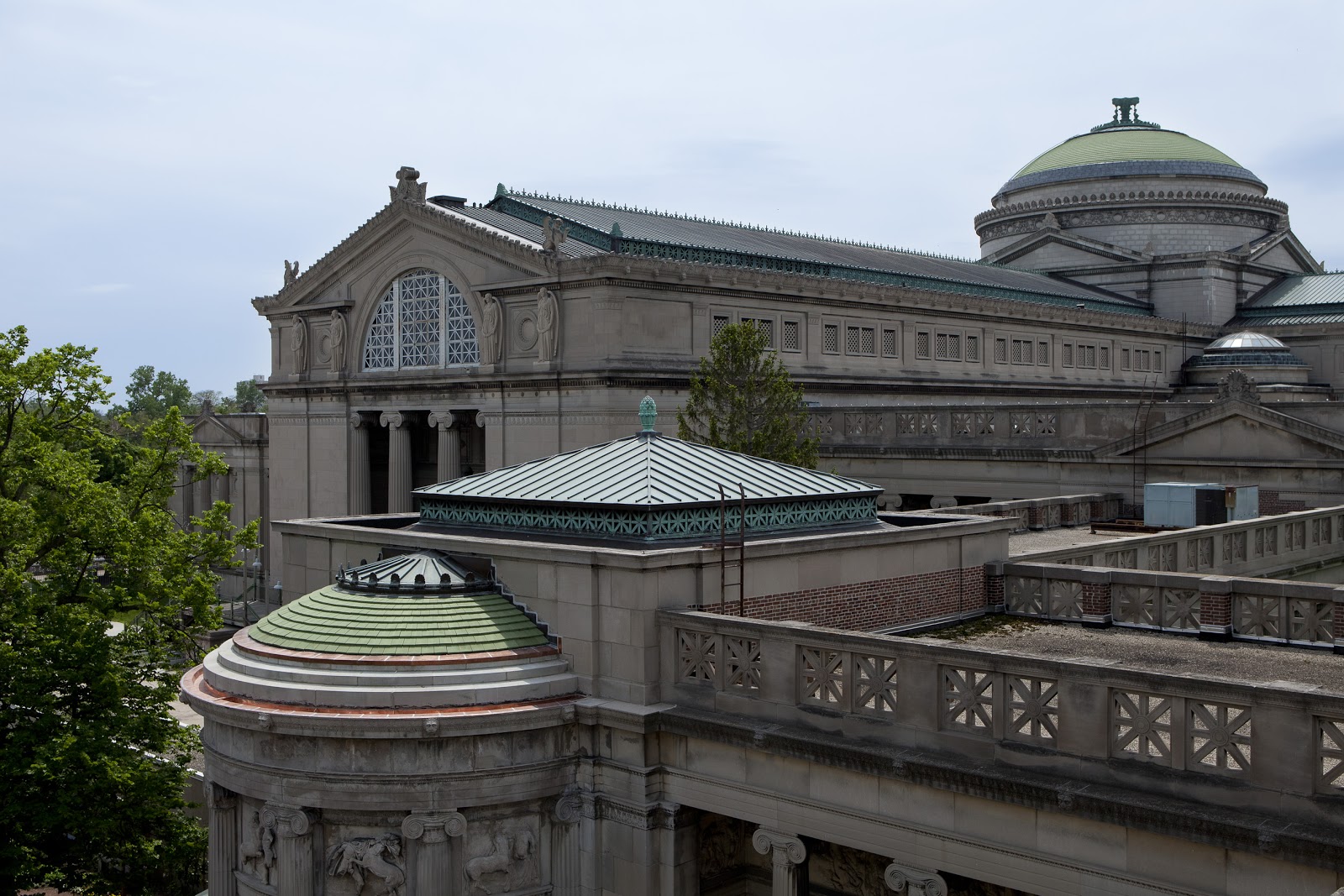
Museum of Science and Industry, Chicago.
Photo courtesy of Museum of Science and Industry, Chicago.

The same building as it appeared over 100 years ago:
The Palace of Fine Arts at the World's Columbian Exposition, 1893,
photographer C.D. Arnold.
Source:  Wikimedia Commons

Museum of Science and Industry, Chicago
57th Street and Lake Shore Drive
Chicago, IL


The Treasure:  Located in the only remaining major building from the 1893 World’s Columbian Exposition, the Museum of Science and Industry, Chicago is the largest science center in the country.

Accessibility:  The Museum of Science and Industry, Chicago is open daily from 9:30 to 4, with occasional special extended hours.

Background:   In 1893, millions of people from all over the world flocked to Chicago to see the White City and its many attractions. Officially known as the World’s Columbian Exposition but often referred to as the Chicago World’s Fair, this massive celebration of the Gilded Age opened in May 1893 and closed just seven months later in October. In that short time, an estimated 27 million people visited the fair. Then the gates closed, the people went home, and nearly all the 200 buildings were soon lost to fire or neglect. Of the major buildings that were located in Jackson Park, only the Palace of Fine Arts remains, reopened as the Museum of Science and Industry, Chicago in 1933.

The Save America's Treasures grant
enabled the Museum of Science and
Industry, Chicago to address the
building's exterior masonry, including
the carved limestone.
Photo courtesy of the Museum of
Science and Industry, Chicago.
Chicago architect Daniel Burnham of Burnham and Root served as Director of Works in charge of the World’s Columbian Exposition, pulling together a distinguished team of architects who had to work on tight schedules and limited budgets. White stucco was used on most building exteriors and this “white” effect was then amplified by the use of new-fangled electric street lights, prompting the nickname “the White City” for the centerpiece Court of Honor area. The extensive grounds were designed by Frederick Law Olmstead, the extraordinarily influential landscape designer of Central Park in New York City as well as many other major urban parks.

The Palace of Fine Arts was a sturdier building than many at the fair. Designed by architect Charles B. Atwood, the Palace of Fine Arts was constructed with a brick substructure that was then plastered over with the white stucco. Extra care went into its construction since it was to be the showcase for loaned art masterpieces from other countries. In a city known for its fires, the Palace of Fine Arts needed to be fireproof.

After the fair, the building became the home of the Columbian Museum of Chicago, renamed the Field Museum of Natural History in 1905. One of Chicago’s most venerable institutions, the Field Museum moved out of Jackson Park and to its current location in the Chicago Park District in 1921. For several years, the large building lay vacant. Fortunately, it was rescued for new use by philanthropist Julius Rosenwald, president of Sears, Roebuck and Company, who pledged millions toward the establishment of an industrial museum to inspire children to become engineers, scientists, and doctors. While the conversion of the building included a replacement of the original exterior plaster with Indiana limestone, the overall appearance of the building today remains remarkably similar to how it looked when it was the Palace of Fine Arts in the White City in 1893.

One of Chicago’s most popular attractions, the Museum of Science and Industry, Chicago sprawls over 14 acres, offering more than 400,000 square feet of exhibit space. It’s the largest science center in the western hemisphere and has welcomed more than 175 million guests since it opened in 1933. Among the most physically impressive of the 35,000 artifacts at the museum, there’s the Apollo 8 space capsule, a German U-boat submarine, and a United Boeing 727 aircraft that’s cantilevered to the museum’s east balcony.

The highly decorative areas of the Museum's East and West Pavilions were
most affected by Chicago's extreme weather.
Photo courtesy of the Museum of Science and Industry, Chicago.

Closeup view of the Museum's East Knuckle rooftop.
Photo courtesy of the Museum of Science and Industry, Chicago.

Notes from the Editor:  There are always special exhibits and events at the Museum of Science and Industry, Chicago but this one particularly interests me:  In 2012, the museum has been celebrating its origins with “The White City… Then and Now.” Offered on special days, it combines a virtual simulation tour of the World’s Columbian Exposition as it would have looked in 1893 with a 25-minute architectural walking tour.

Like many people, my interest in the World’s Columbian Exposition was piqued by Erik Larson’s non-fiction bestseller Devil in the White City. I suspect most readers are lured to the book by the real-life horror story of the serial killer H.H. Holmes. But while that story is undeniably fascinating, it’s easily matched in intensity by the parallel story of Daniel Burnham’s heroic efforts to build the World’s Fair and make it an international success for Chicago. In this rare instance, I thought the hero stole the show from the villain.

Other Important Sites:  Check Chicago’s tourism websites to see if there are any tours of World’s Columbian Exposition locations. While the Museum of Science and Industry provides the best indication of the actual scale and appearance of the White City, other remnants of the fair remain. Daniel Burnham led the effort to build the fair from the 11th floor of the Rookery Building (209 South LaSalle Street), a handsome building that the Burnham and Root firm designed in 1888. Various trees and lagoons in Jackson Park date back to the fair’s original landscaping. The Wooded Isle in Jackson Park was the site of Olmstead’s Japanese Garden. Midway Plaisance, a grassy median that runs through the University of Chicago, served as the main grounds of the fair. Here construction crews recently unearthed the foundations that supported the giant Ferris wheel that was one of the White City’s most famous attractions.

Chicago World's Fair 1893, a chromolithograph by H.D. Nichols,
published by L. Prang and Co. From the collection of the Boston Public Library.
Source:  Wikimedia Commons

Tour America's History Itinerary
Tuesday’s (10/30) destination:  1992 Election Documentary Collection

© 2012 Lee Price