Tour America's Treasures


An invitation to tour America's historical sites...

Thursday, July 25, 2013

Fallingwater


View Fallingwater in a larger map

Visit our Tour Destination: Pennsylvania page to see the entire tour of the state’s Save America’s Treasures sites.

Fallingwater.
Photo courtesy of Western Pennsylvania Conservancy.

Fallingwater
1491 Mill Run Road
Mill Run, PA

Website:  Fallingwater

The Treasure:  A Frank Lloyd Wright masterpiece, Fallingwater is his iconic house on the waterfall—a sublime embodiment of Wright’s belief in “organic architecture.”

Accessibility: Advance ticket purchase is essential for all tours at Fallingwater. From April through November, the site is open daily (except Wednesday). Check the website for limited hours in March and December. The house is closed for tours in January and February, although Grounds Passes may be available, weather permitting.

First view of Fallingwater from the trail.
Photo by Lisa Price, courtesy of
Western Pennsylvania Conservancy.
Background:  Fallingwater is nestled deep within a tranquil Appalachian oak forest. The beauty of the wilderness is enhanced by the Bear Run stream that cascades over ledges of Pottsville sandstone, creating picturesque waterfalls. As you approach, you can hear the falling water before you see the house. Fallingwater is a multi-sensory experience.

The wealthy owner of Kaufmann’s Department Store in Pittsburgh, Edgar Kaufmann (1885-1955) and his wife Liliane (1889-1952) were attracted to this rustic getaway, located in the mountains southeast of Pittsburgh, for its beauty and cool mountain air. In 1916, they altruistically fashioned the property as a weekend retreat, first offering it to their female employees and later extending the invitation to the men as well. At the Kaufmann’s summer camp, the air was clean, the pace was relaxed, and there were opportunities for hiking, swimming, fishing, and horseback riding.

In the 1930s, with the Great Depression severely decreasing use of the retreat by his employees, Kaufmann began to consider other uses for the property. Dedicated to early principles of land conservation, he was committed to keeping the primal Appalachian splendor of the land intact. But he was open to new aesthetic ideas, too. His son, Edgar Kaufmann jr., introduced his father to architect Frank Lloyd Wright’s revolutionary ideas. Wright’s concept of “organic architecture,” harnessing local materials to create modern buildings in harmony with the natural landscape, deeply appealed to Kaufmann. In 1934, he commissioned Wright to build his family a weekend vacation house showcasing the view of a particularly beautiful thirty-foot waterfall.

Kaufman pictured his new house facing the waterfall, so Wright’s proposal came as a surprise: he placed the house immediately above the falls, with decks cantilevered from a rock ledge and the stream’s water perpetually falling underneath the residence. In Wright’s vision, the house wouldn’t be a place for viewing a beautiful scene—it would be an essential new component of the beautiful scene. To their credit, the Kaufmanns thoughtfully considered and then embraced Wright’s approach. Both in its interior and its exterior, Fallingwater was conceived as a part of its environment.

When the main house was completed in 1937, Fallingwater was swiftly promoted to fame by a January 1938 Time cover story. Then 70 years old, Wright capitalized on his renewed fame with vigor and imagination—there were more astonishing masterpieces in him, including New York City’s famous Guggenheim Museum.

Reflecting on his work at Fallingwater, Wright later said:

“Fallingwater is a great blessing—one of the great blessings to be experienced here on earth. I think nothing yet ever equaled the coordination, sympathetic expression of the great principle of repose where forest and steam and rock and all the elements of structure are combined so quietly that really you listen not to any noise whatsoever although the music of the stream is there. But you listen to Fallingwater the way you listen to the quiet of the country…”
Frank Lloyd Wright
Talk to the Taliesin Fellowship
May 1, 1955


Interior view of the Hatch looking toward the west terrace.
Photo by Robert P. Ruschak,
courtesy of Western Pennsylvania Conservancy.

Notes from the Editor:  Fallingwater was the grand conclusion of my family’s Chicago vacation a couple of years ago. First, we visited the Frank Lloyd Wright Home and Studio in Oak Park and enjoyed their walking tour of Wright-designed buildings in the area, including Unity Temple. Then on our trip back to New Jersey, we spent a lovely day at Fallingwater.

The editor at Fallingwater.  Photo by Lisa Price,
courtesy of Western Pennsylvania Conservancy.

Other Recommended Sites:  There’s another acclaimed Frank Lloyd Wright building less than seven miles from Fallingwater. One of the last residential homes to be completed by Wright, Kentuck Knob complements Wright’s earlier work at Fallingwater. Perched near the summit of a 2,050-foot mountain, it simultaneously celebrates and blends into the landscape of Pennsylvania’s beautiful Laurel Highlands.

View of the living room at Fallingwater, looking south.
Photo by Robert P. Ruschak, courtesy of Western Pennsylvania Conservancy.

Tour America's History Itinerary

Thursday:  Johnstown Flood National Memorial

© 2013 Lee Price

Friday, July 12, 2013

Moland House Historic Park


View Moland House Historic Park in a larger map

Visit our Tour Destination: Pennsylvania page to see the entire tour of the state’s Save America’s Treasures sites.

Moland House in Moland House Historic Park, Warwick Township.
Photo courtesy of the Warwick Township Historical Society.

Moland House Historic Park
1641 Old York Road
Hartsville, PA


The Treasure:  Moland House served as the administrative headquarters for George Washington and other Continental Army leaders during the 13-day Neshaminy Encampment in August 1777.

Accessibility:  The twelve-acre park is open during daylight hours year round. Guided tours of Moland House are available from 1 to 4 on the second Sunday of every month and additionally on the fourth Sunday from 1 to 4 between April and October.

Background:  The Continental Army arrived in Warwick Township, at the intersection of York and Bristol Roads in Bucks County, on August 10, 1777. There were probably no more than 500 people living in the township at the time, but it was a settled area with a church, a tavern, a mill, and ready access to fresh water thanks to the Neshaminy Creek. The local residents, primarily Scotch-Irish, were natural supporters of the struggle for independence.

The Council-of-War Room at Moland House.
Photo courtesy of the Warwick Township Historical Society.
In one day, approximately 11,000 Continental and militia soldiers arrived in town, swelling the population by more than 2,000%.  The troops came from Morristown, New Jersey, where they had been keeping tabs on the British troops in New York under the leadership of General William Howe. When Howe’s troops sailed south, Washington and the Continental Army followed by land, unsure of where the British troops would choose to strike next. They took a holding position north of Philadelphia, waiting to hear if an attack on the city was imminent. Warwick Township was identified as a discreet location to await solid information.

Washington and his staff moved into Moland House, almost certainly the finest residence in the area. A substantial stone farmhouse, Moland House was built by John Moland in the mid-1700s. John Moland was a well-respected lawyer who appears to have worked in both Philadelphia and Bucks County. He died in 1761, leaving a widow and five children. While it would have been inconvenient to have her house at the center of all the military activity, Catherine Moland probably appreciated any reimbursements that Washington provided (records exist showing settled bills for food and furniture, as well as a final cleaning of her kitchen).

The Neshaminy Encampment, as it is known, came between the Crossing of the Delaware and Battle of New York in late 1776 and the looming Battle of Germantown in October (followed by the famous winter encampment at Valley Forge). Nine days into the 13-day Neshaminy Encampment, the Marquis de Lafayette arrived on the scene and joined the leaders of the Continental Army in their deliberations at Moland House. According to legend (and no facts appear to contradict it), Betsy Ross’ “Stars and Stripes” flag may have been unfurled for the first time as the troops left Warwick Township on August 23, heading down York Road toward Philadelphia.

Today, the Warwick Township Historical Society manages the historic home and surrounding park for Warwick Township. They host frequent special events and annual reenactments of the Neshaminy Encampment, as well as guided tours of the historic house.

As seen here, Moland House fell on hard times in the 1960s, '70s, and '80s.
In 1996, Warwick Township received ownership of the abandoned house.  The
following year, they entered into a management agreement with the Warwick
Township Historical Society to restore, maintain, and operate the property.
Photo courtesy of the Warwick Township Historical Society.

In 2002, Save America's Treasures contributed funding to
support the restoration of the historic Moland House.
Photo courtesy of the Warwick Township Historical Society.

Other Recommended Sites:  In nearby Warminster, you can visit Historic Craven Hall, a stately Federal/Greek Revival Home. The grounds of Craven Hall also host the John Fitch Steamboat Museum which celebrates Fitch’s invention of the first commercial steamboat, which made its maiden trips on the Delaware River in the summer of 1790.

George Washington's office during the Neshaminy Encampment at Moland House.
Photo courtesy of the Warwick Township Historical Society.

Tour America's Treasures Itinerary
Thursday:  Academy of Natural Sciences of Drexel University

© 2013 Lee Price


Wednesday, July 3, 2013

Gettysburg National Military Park


View Gettysburg National Military Park in a larger map

Visit our Tour Destination: Pennsylvania page to see the entire tour of the state’s Save America’s Treasures sites.

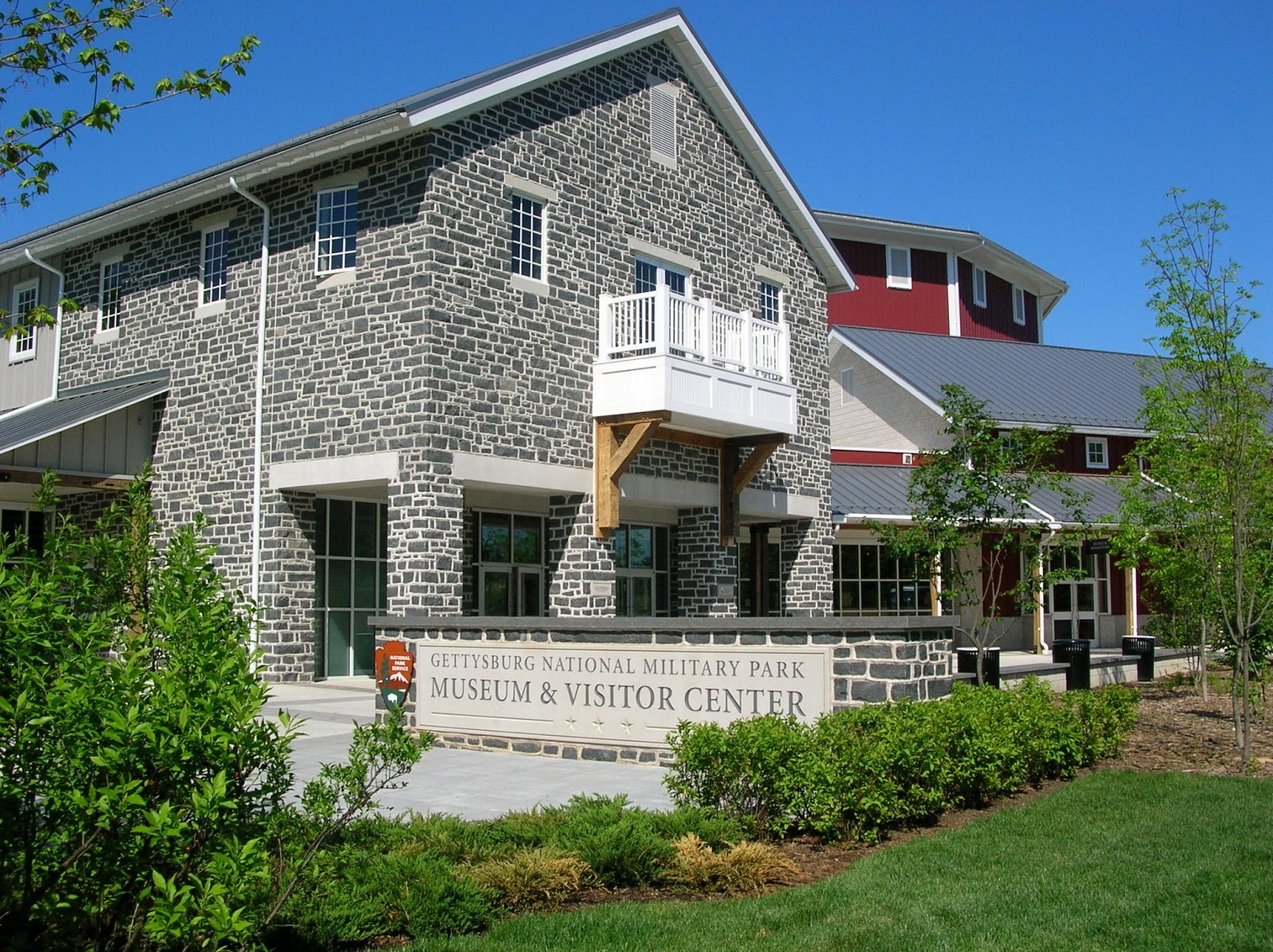
Gettysburg National Military Park Museum and Visitor Center.
Photo courtesy of Gettysburg National Military Park.

Gettysburg National Military Park
Museum and Visitor Center
1195 Baltimore Pike (Route 97)
Gettysburg, PA


Gettysburg  (site of the Gettysburg Foundation)

The Treasure:  The Gettysburg National Military Park Museum and Visitor Center preserves approximately 300,000 artifacts and 700,000 archival documents that bear witness to the Civil War, the Battle of Gettysburg, and a century-and-a-half of reflections and commemorations. 

Accessibility:  The park is open daily from 6 a.m. to 10 p.m. from April through October and from 6 a.m. to 7 p.m. from November through March.  The Museum and Visitor Center is open daily from 8 to 6 from April through October and 8 to 5 from November through March.

Background:  “Now we are engaged in a great civil war, testing whether that nation, or any nation so conceived and so dedicated, can long endure. We are met on a great battle-field of that war. We have come to dedicate a portion of that field, as a final resting place for those who here gave their lives that that nation might live. It is altogether fitting and proper that we should do this.”
Abraham Lincoln
The Gettysburg Address
delivered on November 19, 1863

Ranger program at Devil's Den.
Photo courtesy of Gettysburg National Military Park.
Lincoln went on to say that the ground of Gettysburg was hallowed not by his words but by the men who fought here. Strolling through the nearly 6,000-acre park today, perhaps on one of the informative ranger guided programs, it can sometimes be difficult to imagine war visiting this now-bucolic landscape of fields, pastures, orchards, and woodlots. People come here to reflect upon a turning point in the country’s history, a nation’s destiny pivoting upon the single bloodiest battle ever fought on American soil. With Confederate troops under the leadership of General Robert E. Lee and Army of the Potomac troops under General George Meade, more than 160,000 men clashed here. Nearly a third of them—51,000—died here.

While the scope of the Battle of Gettysburg can best be appreciated by walking the park grounds, hundreds of individual stories are evoked by the artifacts displayed at the Gettysburg National Military Park Museum and Visitor Center. These artifacts offer a tangible link to the lives of the soldiers. Each piece has a story to tell. Someone wore this uniform, played this bugle, read this letter, drank from this cup, and shot this gun. Robert E. Lee sat at this camp desk. A soldier carried this pocket-size Manual of the Christian Soldier, and he died when a bullet passed clean through it. You can see the bullet hole.

For many years, Gettysburg’s visitor center was located on Cemetery Ridge, the famous site of Pickett’s Charge, a last-gasp Confederate infantry assault on the third day of battle. With the donation of 50 acres neighboring the park in 2000, the Gettysburg Foundation and the National Park Service were able to build a new center, enabling them to return the original Cemetery Ridge site to park land, more appropriate for interpretation and commemoration. In 2008, the new Museum and Visitor Center opened, with nearly double the amount of museum exhibition space than previously available.

John Brown's cell door.
Photo courtesy of
Gettysburg National
Military Park.
Save America’s Treasures funding contributed to the conservation and rehousing of many of the artifacts now displayed in the exhibition areas. It is one of the country’s great Civil War collections. The core of it dates back to a collection that began all the way back in 1863 when 16-year-old John Rosensteel began picking up interesting items, instituting a family tradition of collecting Gettysburg artifacts. Later bequeathed to the National Park Service, the George Rosensteel Collection continues to be the center piece of the museum.

The exhibits at the Museum and Visitor Center interpret the Battle of Gettysburg from many perspectives, including the origins of the conflict. A door from the Harpers Ferry prison cell where John Brown served time during his trial is among the most popular artifacts. It is a potent reminder of the many tensions that once enflamed the country, as incident after incident led inexorably to civil war.

Notes from the Editor:  This blog entry posted on July 3, 2013, as we commemorate the 150th anniversary of the third and final day of the Battle of Gettysburg.

Other Recommended Sites:  From the Museum and Visitor Center, shuttle buses are available to the neighboring Eisenhower National Historic Site, the home and farm of General and President Dwight D. Eisenhower.

Temporary entrenchments erected by Federal troops on Gettysburg's
Little Round Top, with Big Round Top in the distance.
Photographed in July 1863 by Timothy H. O'Sullivan,
from Library of Congress Prints and Photographs Division.

Tour America's History Itinerary
Tuesday:  Moland House

© 2013 Lee Price

Tuesday, June 25, 2013

Pennsylvania State Archives: Civil War Muster Rolls


View Pennsylvania State Archives in a larger map

Visit our Tour Destination: Pennsylvania page to see the entire tour of the state’s Save America’s Treasures sites.

Project Conservator Lindsay Bergen pieces together
the Muster Out Roll of Co. K of the 71st Regiment.
Photo courtesy of the Pennsylvania State Archives.

Pennsylvania State Archives:
Pennsylvania Civil War Muster Rolls
North Third and Forster Streets
Harrisburg, PA


The Treasure:  A wealth of important historical information is preserved on the Pennsylvania Civil War Muster Out Rolls, which record key details on approximately 362,000 soldiers from the Commonwealth of Pennsylvania who served in the Civil War.

Accessibility:  Information on how to research the Civil War documents at the Pennsylvania State Archives is available at the web page Civil War Records at the Pennsylvania State Archives. The Civil War Muster Rolls are being scanned by Ancestry.com and are anticipated to be accessible online by late summer 2013.

Archivist Rich Saylor in the archives
tower stack area with the 135 cartons
of Muster Out Rolls before treatment.
Photo courtesy of the
Pennsylvania State Archives.
Background:  As the Civil War came to a close in 1865, the Pennsylvania Adjutant General’s Office confronted a flood of paper from the field. The Adjutant General’s Office had responsibility for much of the paperwork of war, covering Muster In Rolls (documenting the entry of soldiers into service), Alphabetical Rolls, Lists of Deserters, and Muster Out Rolls (documenting the status of soldiers at the completion of their service). These were the state’s databases, prepared and organized by hand. Many of the Muster Out Rolls date from the war’s end, as companies moved through the business of disbanding.

Ultimately, the Pennsylvania Adjutant General’s Office collected over 2,500 muster-out rolls, recording the exit status of approximately 362,000 soldiers. Only New York State contributed more Union soldiers to the war effort than Pennsylvania. A number of Pennsylvanians became prominent leaders in the cause. Noted generals from Pennsylvania include George Meade, George B. McClellan, Winfred Scott Hancock, John Fulton Reynolds, John F. Hartranft, and John W. Geary. But the Muster Out Rolls are egalitarian—they studiously document the status of the legendary Civil War heroes alongside the common soldiers and even the deserters.

A typical muster roll, before treatment:  Note the damage
on the folds that were mended with pressure-sensitive tapes.
Photo courtesy of the Pennsylvania State Archives.
As the companies disbanded, the field clerks gathered the information, including the status of company members who were missing or dead. The Adjutant General’s Office provided the oversize forms—unfolding to more than three feet in width and two feet in height. Under the pre-printed masthead, the officers and clerks would fill in the information on the ruled lines. The status of dozens of soldiers could be recorded on each document. Notes provide tantalizing information, now deeply valued by today’s historians and genealogists:  “prisoner at Andersonville,” “wounded at Chancellorsville,” “recovering in hospital,” “deserted,” “lost,” or “died at Antietam.”

For the first half-century of their existence, the Muster Out Rolls were valued primarily for very practical reasons, such as verifying pensions and veteran’s claims. Subsequently, historians and genealogists continued the high level of demand. Time after time, the documents were unfolded then refolded, becoming blemished with dirt and grime. Losses started to occur along the weakening folds. Well-meaning office workers applied highly acidic pressure-sensitive tapes to hold the sheets together. Historians and genealogists loved the accurate and color detail in the documents, but the paper itself was literally falling apart.

Conservator Joan Irving at the Conservation Center for
Art and Historic Artifacts with State Archivist David Haury
and an artillery regiment Muster Out Roll.
Photo courtesy of the Pennsylvania State Archives.

Notes from the Editor:  With funding from Save America’s Treasures and the Pennsylvania General Assembly, the Pennsylvania Muster Out Rolls have received state-of-the-art treatment and rehousing. More than 1,000 of the documents—the ones judged to be in the worst condition—came for treatment to the Conservation Center for Art and Historic Artifacts (CCAHA) where I work. For more than five years, our conservators and technicians had the privilege to work on this monumental project.

The treatment required surface cleaning, washing, mending, flattening, lining, and encapsulating. All the old acidic mending tapes had to be removed, sometimes loosening fragments of paper that had to be refitted into the document like in a jigsaw puzzle. In 2009, CCAHA Book Technician Valeria Kremser (now Book Conservation Technician at the University of Pennsylvania) produced an informative short video, The Pennsylvania Civil War Muster Roll Project. The time-lapse section offers a nice insight into the challenging work of piecing the documents back together. Multiply this one treatment by more than a thousand and you’ll have some idea of the scope of this work.


Above:  Before treatment image of a folded Muster Roll.
Below:  After treatment image of the same Muster Roll, now unfolded.
Photo courtesy of the Pennsylvania State Archives.

Other Recommended Sites:  In the Pennsylvania State Capitol complex in Harrisburg, you can visit the Pennsylvania State Archives and the neighboring State Museum of Pennsylvania, and then take a guided tour of the historic State Capitol Building itself.

The Pennsylvania State Archives.
Photo courtesy of the
Pennsylvania State Archives.

Tour America's History Itinerary

Tuesday:  Gettysburg National Military Park

© 2013 Lee Price


Thursday, June 20, 2013

Bulgarian Macedonian National Educational and Cultural Center


View Bulgarian Macedonian National Educational and Cultural Center in a larger map

Visit our Tour Destination: Pennsylvania page to see the entire tour of the state’s Save America’s Treasures sites.

The museum area at the Bulgarian Macedonian National Educational and
Cultural Center showing the archival-quality cabinets, featuring Bulgarian-style
embellishments, built by renowned Japanese woodworking artist Tadao Arimoto.
Photo courtesy of the BMNECC.

Bulgarian Macedonian National Educational and Cultural Center
West Eighth Avenue
West Homestead, PA


The Treasure:  A large collection of artifacts illuminates the fascinating culture that Bulgarian and Macedonian immigrants brought with them as they settled into a new life in America.  

Accessibility:  The Bulgarian Macedonian National Educational and Cultural Center is open Tuesdays through Thursdays from 10 to 1, Saturdays from 9 to noon, and other hours by appointment.  There’s a busy schedule of special events most months.  Check the calendar for what’s going on.

Background:  First, some basic geography: Roughly the size of Virginia, Bulgaria is located is southeastern Europe, bordering the Black Sea to the east, Romania to the north, Greece and Turkey to the south, and Serbia and Macedonia to the west. Considerably smaller, Macedonia is approximately the size of Vermont and is an entirely landlocked country, surrounded by Kosovo, Serbia, Bulgaria, Greece, and Albania. From 1944 until its independence in 1991, Macedonia was the southernmost republic within Yugoslavia. Nestled on the Balkan Peninsula, Bulgaria and Macedonia have maintained a rich cultural heritage in the face of frequent foreign occupations.

BMNECC Chairwoman Emerita Patricia
Penka French standing in front of the
78-year-old Bulgarian Cultural Center. The
building's facade was refurbished in 2005
thanks to a grant from the Pittsburgh
History and Landmarks Foundation.
Photo courtesy of the BMNECC.
In the early years of the 20th century, many Bulgarians and Macedonians left their homelands to find new opportunities in America. It was a time of relative freedom in both countries—between the time of the Turkish Ottoman rule that ended in 1878 and the rise of the Iron Curtain after World War II, but economic conditions prompted many to try their luck abroad. They came to the American heartland looking for steady work, responding to the demand for labor in the factories and mines.

The thriving steel mills of Pittsburgh attracted many immigrants. The new arrivals brought their culture and customs with them, adapting as best they could to their new home. In 1930, a group of citizens founded the Bulgaro-Macedonian Beneficial Association in West Homestead, located southeast of Pittsburgh, across the Monongahela River. Like many immigrant organizations, the Association was formed to help immigrant families succeed in the new American environment.

Fifty years later, with the decline of the steel industry in 1980s, the Association began to look for a way to stay relevant. In 1995, they officially dissolved the original organization and founded a new one—the Bulgarian Macedonian National Educational and Cultural Center. The new focus was on celebrating and preserving a unique immigrant culture with strong ties to its Balkan homelands.

At the Bulgarian Macedonian National Educational and Cultural Center, you’ll find music, dance, and a Soup Sega! kitchen that specializes in ethnic Bulgarian specialties. The Save America’s Treasures grant contributed to the retrofitting of a new exhibit space where the historic artifacts—textiles and costumes, artwork, icons, photographs, films, audio recordings, musical instruments, jewelry, and metal work—could be displayed in attractive archival-quality cabinets. Looking outward for new ways to share their heritage, the Cultural Center has recently led initiatives such as Opera from Bulgaria—an Audio Encyclopedia Project, providing access to a rich tradition of Bulgarian opera and opera singers for the benefit of classical music fans and researchers.

Other Recommended Sites:  The main museum of the Rivers of Steel National Heritage Area is located in the neighboring borough of Homestead. Here you can learn about the steel business that once supported so many of the immigrant families.

Thanks to the Save America's Treasures grant, the BMNECC was able
to create a full-service technology center, as well as support for the
cleaning, repairing, and rehousing over 200 historic films in their collection.
Photo courtesy of the BMNECC.

Tour America's History Itinerary
Tuesday:  Civil War Muster Rolls at the Pennsylvania State Archives

© 2013 Lee Price

Friday, June 14, 2013

Atmosphere and Environment XII


View "Atmosphere and Environment XII" by Louise Nevelson in a larger map

Visit our Tour Destination: Pennsylvania page to see the entire tour of the state’s Save America’s Treasures sites.

Atmosphere and Environment XII by Louise Nevelson.
Photo by Joe Mikuliak,
courtesy of the Association for Public Art.

Atmosphere and Environment XII
Philadelphia Museum of Art, West Entrance
Art Museum Drive
Philadelphia, PA


… and click here for information on the wide variety of Philadelphia’s public art maintained by the Association for Public Art.

The Treasure:  Atmosphere and Environment XII is an 18,000-pound masterpiece of modern sculpture.

Background:  There are two great sculptures in highly visible positions outside the west entrance (that’s the side overlooking the Schuylkill River—not the more iconic side with the Rocky steps) of the Philadelphia Museum of Art. As you approach the west museum entrance, Social Consciousness, a 1954 bronze sculpture by Jacob Epstein, is to your left. And to the right is our Save America’s Treasures piece:  Atmosphere and Environment XII by the acclaimed American sculptor, Louise Nevelson (1899-1988).

Deinstallation of Atmosphere and
Environment XII in 2005.
Photo by Joe Mikuliak, courtesy of
the Association for Public Art.
Although labeled XII by Nevelson, this particular sculpture is really the third in a series of four that runs from X through XIII. Each subtly different, the four sculptures were created late in Nevelson’s career, at a time when she was experimenting with monumental size and new materials like Cor-Ten, a recently developed weathering steel. The first, Atmosphere and Environment X, was conceived in 1969 as a commission for Princeton University, followed by XI for Yale University, then XII which was constructed in 1970 and purchased by Philadelphia’s Fairmount Park Art Association (now the Association for Public Art) in 1972, and finally XIII for Scottsdale, Arizona.

“Environments” is a term that Nevelson frequently used to refer to her famous collages. In the 1950s and 1960s, she constructed a wide variety of collages from wood and found objects, creating intricate arrangements and then painting them a solid color—first entirely black, then all white, with a brief “baroque” period of gold.

While the word “Environment” in the Atmosphere and Environment series refered back to her earlier works, “Atmosphere” added something new to Nevelson’s art. “The landscape is the atmosphere that fills the spaces of the steel environment,” she explained. “The two together are the sculpture.” Unlike her earlier collages, this new series of massive outdoor sculptures was created to interact with the changing world around it—in her words, the atmosphere. The large scale of the works may have been partly inspired by her interest in Mayan ruins and theater sets.

Like many modern artists, Nevelson embraced transience with her Atmosphere and Environment series. The atmosphere—the scenery viewed both behind and through the sculpture—would inevitably change over time. The appearance of the steel would change as well, as it developed a distinctive rust patina. But Nevelson would probably not have predicted that the very structure of the sculpture would quickly become threatened by “corrosion jacking,” with the buildup of corrosion materials actually moving the sculpture’s box-shaped elements apart.

"Before treatment" image showing
corrosion jacking on the box elements.
Photo courtesy of the
Association for Public Art.
Funding from Save America’s Treasures, the Getty Foundation, and The Locks Foundation was raised to address the problem of the corrosion jacking. Working with the Association for Public Art, the Conservation Department of the Philadelphia Museum of Art developed innovative treatment approaches to restore the disfigured box elements. It was a five-year process, including the challenging deinstallation of the sculpture in 2005, followed by months of detailed restoration work, and climaxing with a rededication service on the Art Museum steps in May 2007.

Objects conservator Sara Creange working on the project.
Photo courtesy of the Association for Public Art.

Other Recommended Sites:  The west entrance side of the Philadelphia Museum of Art is a bucolic setting, with a terraced landscape that slopes down to the Schuylkill River and the historic Fairmount Water Works. The Philadelphia Museum of Art recently installed the Anne d’Harnoncourt Sculpture Garden on the west grounds, featuring works by Isamu Noguchi, Sol LeWitt, Claes Oldenburg, Ellsworth Kelly, and others. Iroquois, a monumental sculpture by Mark di Suvero is located nearby, just around the corner on the Benjamin Franklin Parkway.

Philadelphia can also boast another major work by Louise Nevelson. On the other side of Philadelphia’s Center City, Nevelson’s Bicentennial Dawn is located in the interior of the James A. Byrne Federal Courthouse on 601 Market Street.


Conservators who worked on Atmosphere and
Environment XII
at the rededication service in 2007.
Photo by Joe Mikuliak,
courtesy of the Association for Public Art.

Tour America's History Itinerary

Thursday:  Bulgarian Macedonian National Educational and Cultural Center

© 2013 Lee Price

Friday, May 31, 2013

Delaware Canal State Park


View Delaware Canal State Park, Sommer's Bridge in a larger map

Visit our Tour Destination: Pennsylvania page to see the entire tour of the state’s Save America’s Treasures sites.

The restored Sommer's Bridge in Delaware Canal State Park.
Photo courtesy of Delaware Canal State Park.

Delaware Canal State Park
Sommer’s Bridge
The park is located along the historic canal and towpath
paralleling the Delaware River on the Pennsylvania side
from Easton to Bristol.

Sommer’s Bridge spans the canal
in Lower Makefield Township
approximately a half mile south of I-95.


The Treasure:  The Delaware Canal is a national treasure and the restored bridges that cross it, like the Sommer’s Bridge, add to its authenticity.

Background:  Two years after New York’s Erie Canal opened to lots of fanfare in 1825, the Pennsylvania State Senate passed a bill to dig a canal of its own. There were solid economic reasons for states to invest in canals. As the most cost-efficient commercial transportation systems then available, canals were good for business. Large deposits of anthracite coal had been discovered in northeastern Pennsylvania and there were huge markets for the coal in cities like Newark, New York City, and Philadelphia. To get the coal to Newark and New York City, New Jersey dug the Morris Canal. And in Pennsylvania, the Delaware Canal was constructed to transport the coal to the state’s largest city, mutually benefitting the economies of northeastern Pennsylvania and the growing industries of Philadelphia.

View from Sommer's Bridge.
Photo courtesy of Delaware Canal
State Park.
The digging commenced in October 1827. Nearly five years later, the 60-mile-long canal celebrated the delivery of its first shipment of coal, with a loaded barge traversing the distance from Easton to Bristol. During its first forty years, the Delaware Canal more than justified its $1.43 million expense, fueling the growth of industry in eastern Pennsylvania. The engineering required was impressive:  the canal utilized 23 lift locks to control water flow, along with an array of aqueducts, waste gates, dams, and overflows. But in practice, it didn’t look particularly sophisticated. Slow but steady, teams of mules trudged along the towpath, pulling barges loaded with up to 90 tons of coal.

The heyday of the American canals lasted only a few decades. As new railroad lines were built in the middle of the 19th century, the important role of the Delaware Canal slowly diminished. The last commercial barge descended down the canal in 1931. Appreciative of the historic importance and beauty of the canal and towpath, local citizens have consistently fought for its preservation over the years, from its initial establishment as Theodore Roosevelt State Park in 1940 through today’s maintenance of Delaware Canal State Park by the Pennsylvania Department of Conservation and Natural Resources.

Sign posted during the restoration.
Photo courtesy of Delaware Canal
State Park.
Save America’s Treasures funding was used to preserve one of the original bridges built to span the canal. Dating back to 1831, Sommer’s Bridge is located just 15 miles from the terminus of the canal at Bristol, close to Philadelphia. In the early days, over one hundred small camelback bridges of this type crossed the canal. Today, only six remain. Thanks to the Save America’s Treasures funding, Sommer’s Bridge was the fourth of these surviving historic bridges to be restored.

The best way to see Sommer’s Bridge is to hike the towpath, a National Recreation Trail.

Sommer's Bridge during restoration.
Photo courtesy of Delaware Canal State Park.

Sommer's Bridge, restored.
Photo courtesy of Delaware Canal State Park.

Other Recommended Sites:  A hike along the towpath takes you past one historic site after another, with opportunities for stopovers at several delightful small towns. For iconic national history, Washington Crossing Historic Park is located just three miles north of Sommer’s Bridge. Small towns like Yardley, New Hope, Lumberville, Erwinna, and Upper Black Eddy cater to tourist crowds who come to Bucks County for the scenic riverfront, the antique shops, the bed and breakfast inns, and many fine restaurants.

Delaware Canal State Park.  Photo by Bradford Van Arnum.
Source:  Wikimedia Commons.

Tour America's History Itinerary
Wednesday:  Atmosphere and Environment XII by Louise Nevelson

© 2013 Lee Price